
If you’ve ever typed “vicious” when you meant “viscous” (or vice versa), you’re in good company. These two words trip up even experienced writers because they look nearly identical on the page — same starting letters, same “-ous” ending, same jumble of vowels in between. But their meanings couldn’t be more different. One describes cruelty. The other describes thickness.
This guide breaks down everything you need to know: definitions, pronunciation, real-world examples, synonyms, and the common mistakes that trip people up — so you never confuse them again.
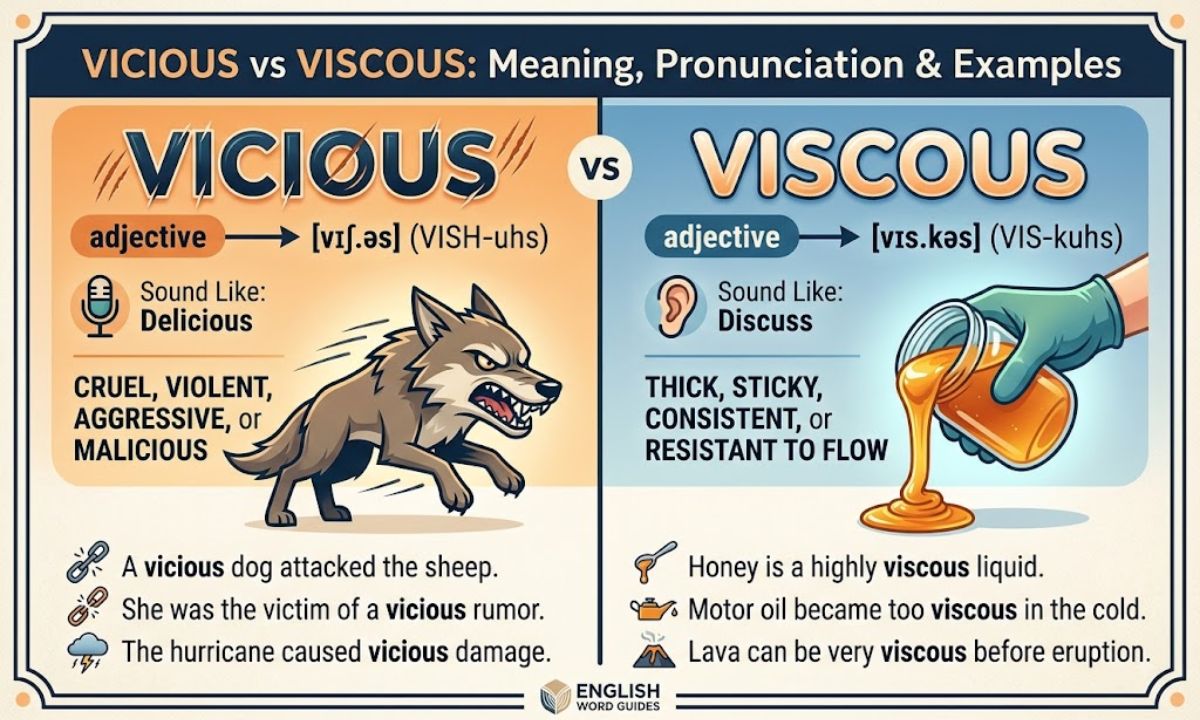
Vicious vs Viscous: The Core Difference
Here’s the simplest way to remember it:
| Word | Category | Meaning | Example |
| Vicious | Behavior/Character | Cruel, violent, aggressive, or malicious | A vicious dog attacked the mail carrier. |
| Viscous | Physical Property | Thick, sticky, slow-flowing | The viscous honey dripped slowly off the spoon. |
Vicious describes actions, animals, people, or situations marked by cruelty or intense hostility. Think of a vicious rumor, a vicious fight, or a vicious storm.
Viscous is a scientific and descriptive term used for liquids or substances that resist flowing easily — think motor oil, syrup, or lava.
Pronunciation Guide: Why They Sound Confusing
Part of the mix-up comes down to how similar these words sound out loud, even though they aren’t true homophones.
- Vicious is pronounced VISH-us (the “ci” makes a “sh” sound)
- Viscous is pronounced VIS-kus (the “sc” makes a hard “k” sound)
That single consonant sound — “sh” versus “sk” — is the entire difference in pronunciation. For non-native English speakers especially, these sounds can blur together when spoken quickly, which is part of why the written confusion happens too.
Why Do People Confuse Vicious and Viscous?
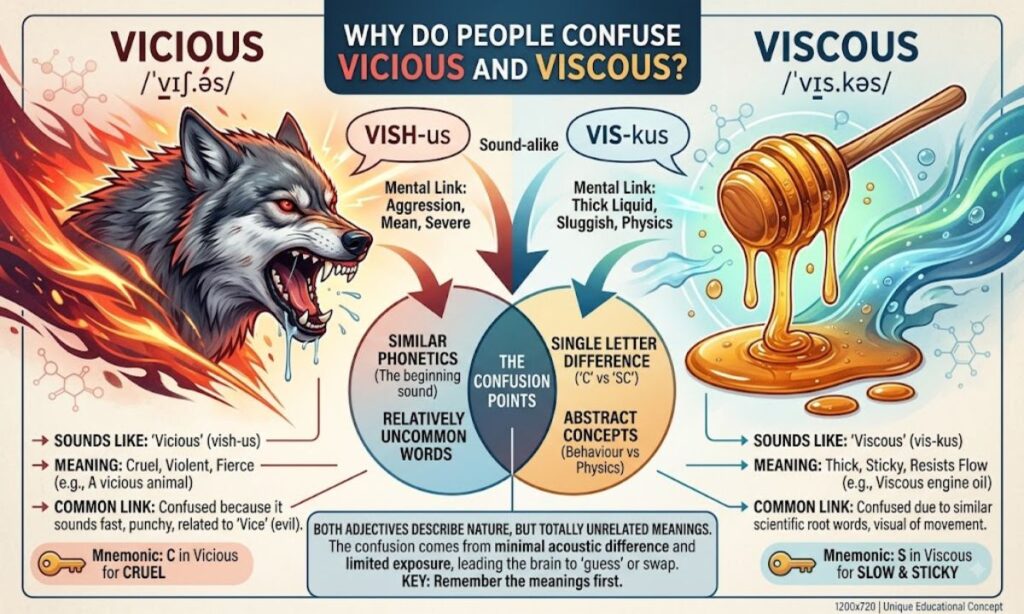
- Visual similarity — Both words share the same first three letters and the “-ous” suffix.
- Frequency imbalance — “Vicious” shows up constantly in everyday conversation, news, and media, while “viscous” is mostly confined to scientific, technical, or culinary writing. When people aren’t sure which word fits, they default to the one they’ve seen more often.
- Autocorrect failures — Spell-checkers sometimes suggest the wrong word when you mistype either one, since both are valid dictionary entries.
- Etymological distance is invisible — Despite looking alike, the words come from completely unrelated Latin roots, but nothing about their spelling signals that to a casual reader.
Vicious Meaning: When Something Is Cruel or Harmful
Vicious is an adjective describing behavior, character, or situations characterized by deliberate cruelty, violence, or malice. It traces back to the Latin vitiosus, related to vice — the same root that gives us words like “vitiate.”
Common uses include:
- Describing aggressive or dangerous animals: “The vicious guard dog kept intruders away.”
- Describing cruel or spiteful behavior: “She spread vicious rumors about her coworker.”
- Describing intense severity, even in non-living contexts: “The vicious storm knocked out power for days.”
- The idiom “vicious cycle,” meaning a self-perpetuating negative pattern.
Viscous Meaning: When Something Is Thick or Sticky
Viscous describes the physical resistance a fluid has to flowing. It comes from the Late Latin viscosus, meaning “sticky,” which itself traces back to viscum — mistletoe, whose berries produce a sticky substance once used to trap birds.
In physics and chemistry, this property is called viscosity — the higher the viscosity, the slower and thicker the substance moves.
Common uses include:
- Describing liquids: “Molasses is far more viscous than water.”
- Describing industrial or natural substances: “The viscous crude oil was difficult to pump through the pipeline.”
- Describing food and cooking: “Simmer the sauce until it becomes thick and viscous.”
Vicious vs Viscous in Real-Life Contexts
Seeing both words in action side by side makes the distinction stick.
| Context | Vicious Example | Viscous Example |
| Animals | The vicious wolf snarled at the campers. | — |
| Weather | The vicious hurricane devastated the coastline. | — |
| Relationships | Their breakup turned into a vicious argument. | — |
| Cooking | — | Whisk the batter until it turns thick and viscous. |
| Science | — | The viscous fluid resisted the pump’s suction. |
| Industry | — | Viscous tar is notoriously hard to transport. |
Vicious in Literature and Media
Writers frequently reach for “vicious” to heighten emotional intensity — describing villains, conflicts, or dramatic turns of fate. A “vicious antagonist,” a “vicious betrayal,” or a “vicious twist” all signal danger, cruelty, or emotional sharpness. News headlines also lean on the word to describe crimes, attacks, or political disputes, since it conveys urgency and severity in just two syllables.
Viscous in Scientific Papers and Cookbooks
“Viscous” belongs to a very different world of writing. In physics and engineering papers, it appears constantly when discussing fluid dynamics, lubrication, and material behavior — describing how substances like oil, glue, or molten metal move under pressure. In cookbooks, it shows up when instructing readers to reduce a sauce “until viscous,” or when comparing the consistency of honey, caramel, or batter. It’s a precision word — used when exact texture matters.
Synonyms and Alternatives of Vicious
If you want to vary your vocabulary instead of repeating “vicious,” consider:
- Brutal
- Ferocious
- Savage
- Malicious
- Ruthless
- Merciless
- Cruel
- Aggressive
Synonyms and Alternatives of Viscous
Similarly, here are alternatives to “viscous” depending on context:
- Thick
- Syrupy
- Gooey
- Sticky
- Gluey
- Sludgy
- Dense (for fluids)
Common Mistakes to Avoid
- Mixing them in writing due to spellcheck suggestions. Always double-check which word your editor selected, especially after autocorrect flags a typo.
- Using “vicious” for physical texture. A syrup is never “vicious” — it’s viscous.
- Using “viscous” to describe personality or behavior. There’s no such thing as a “viscous person” — that word only applies to physical substances.
- Assuming they’re homophones. They aren’t. Saying them aloud with the correct “sh” versus “sk” sound helps reinforce the difference in memory.
- Forgetting context clues. If the sentence involves emotion, danger, or behavior, it’s “vicious.” If it involves liquid, texture, or flow, it’s “viscous.”
Wrapping Up: The Viscous Nature of Vicious Words
English is full of near-twin words that mean nothing alike, and vicious vs viscous is one of the clearest examples. The fix is simple: remember that “vicious” lives in the world of behavior and emotion, while “viscous” lives in the world of physical texture and flow. Once that separation clicks, you’ll never second-guess yourself again — whether you’re writing about a vicious storm or a viscous sauce.
Frequently Asked Questions
Are vicious and viscous homophones?
No. They sound similar but are pronounced differently — “VISH-us” versus “VIS-kus.”
Can a liquid be described as vicious?
Only if you’re personifying it in a figurative sense (like a “vicious current”). Literally, liquids are described as viscous.
What is the noun form of viscous?
The noun form is “viscosity,” referring to a fluid’s resistance to flow.
What is the noun form of vicious?
The noun form is “viciousness,” referring to cruelty or aggressive behavior.
Which word is more common in everyday English?
“Vicious” is used far more often in daily speech and writing, while “viscous” mostly appears in scientific, technical, or culinary contexts.