
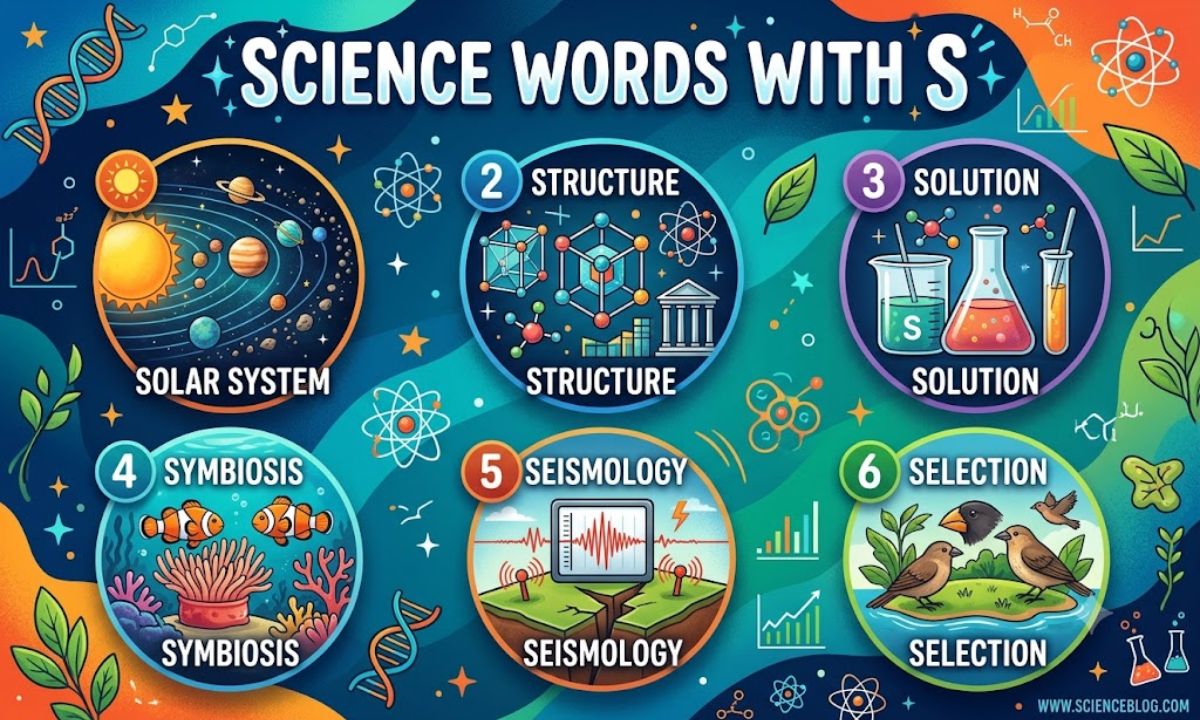
The letter “S” holds a special place in scientific vocabulary. From the tiny building blocks of life to the vastness of space, S-words show up in nearly every branch of science — biology, chemistry, physics, and earth science alike. Whether you’re a student preparing for an exam, a teacher building a vocabulary list, or simply a curious learner, understanding these terms can make science feel a lot less intimidating.
In this guide, you’ll find clear, easy-to-understand definitions of common and advanced science words that start with S, organized by subject. Each term includes a simple explanation and a real-world example so the concept actually sticks.
Why Learning Science Words That Start With S Matters
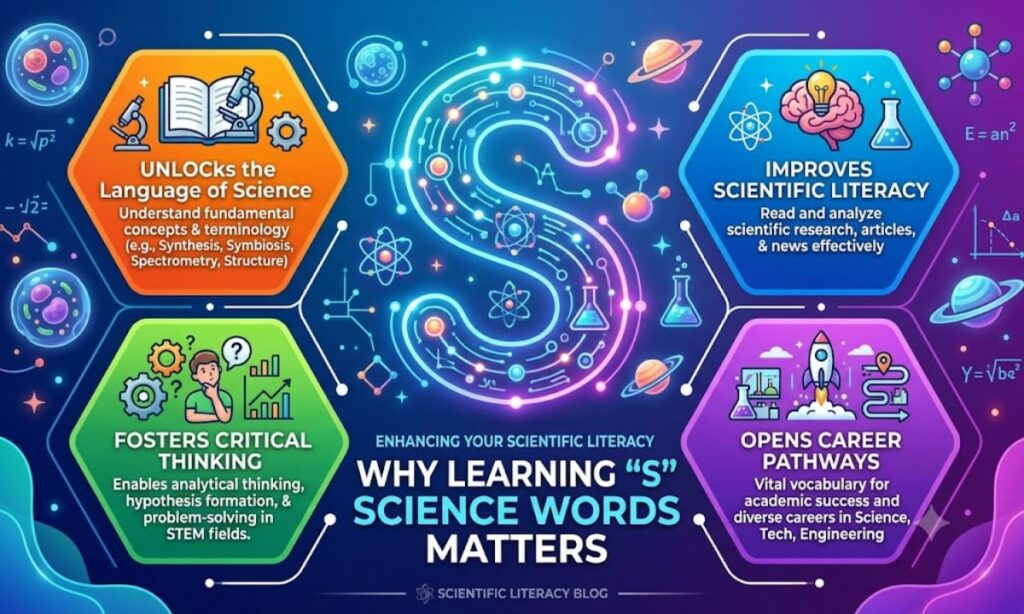
Science vocabulary isn’t just for passing tests. Knowing these words helps you:
- Understand textbooks and lab instructions more clearly
- Follow science news and documentaries with confidence
- Perform better in exams that test scientific literacy
- Build a foundation for advanced study in physics, biology, or chemistry
- Communicate scientific ideas accurately in writing and conversation
A large number of scientific terms beginning with S trace back to Latin and Greek roots — prefixes like sub-, super-, syn-, and semi- appear constantly, which is part of why this letter has such a rich vocabulary bank.
General Science Words That Start With S
These are foundational terms you’ll encounter across almost every branch of science.
| Word | Definition | Example |
| Science | The systematic study of the natural world through observation and experiment | Biology, chemistry, and physics are all branches of science |
| Species | A group of organisms that can breed and produce fertile offspring | Humans belong to the species Homo sapiens |
| Solar Energy | Energy captured from sunlight and converted into usable power | Solar panels convert solar energy into electricity |
| Solution | A uniform mixture where one substance dissolves completely into another | Saltwater is a solution of salt dissolved in water |
| Symbiosis | A close, long-term relationship between two different species | Bees and flowers share a symbiotic relationship |
| Sediment | Solid material such as sand, silt, or rock fragments that settle at the bottom of water or air | Rivers deposit sediment along their banks over time |
| Synthesis | The process of combining simpler substances to form a more complex one | Photosynthesis is how plants synthesize glucose from sunlight |
| System | A group of interconnected parts working together as a whole | The digestive system breaks down food for energy |
| Symmetry | A balanced arrangement where one half mirrors the other | Butterflies display symmetry in their wing patterns |
Quick Recap: Everyday Science Terms
- Sediment relates to geology and erosion
- Synthesis is central to both chemistry and biology
- Symmetry appears in biology, math, and physics alike
Physics Science Words That Start With S
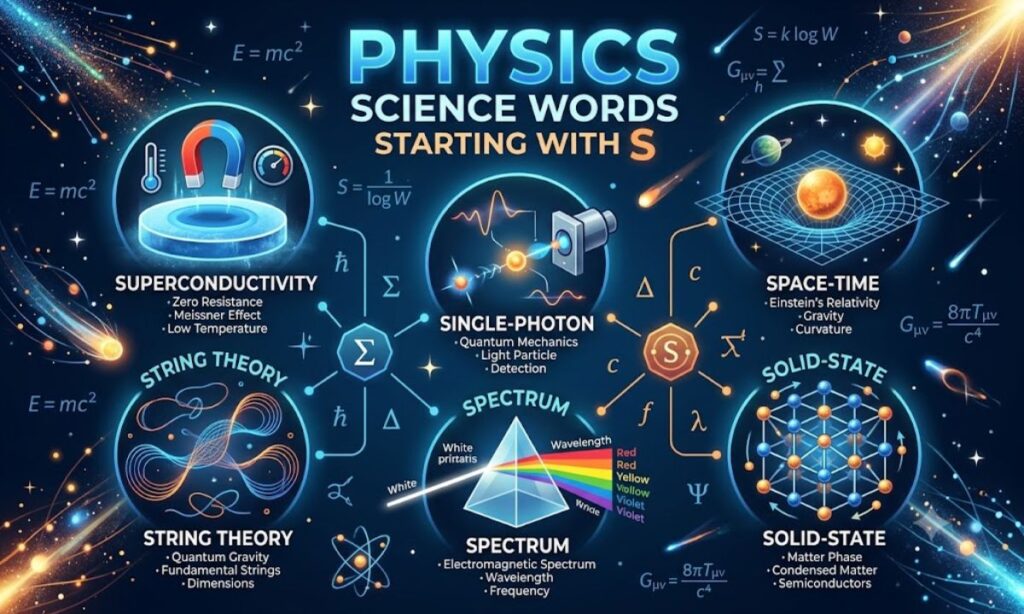
Physics has its own specialized S-vocabulary, often tied to measurement, energy, and material behavior.
| Word | Definition | Example |
| Semiconductor | A material with electrical conductivity between that of a conductor and an insulator | Silicon is a semiconductor used in computer chips |
| Scalar | A quantity described only by magnitude, without direction | Temperature and speed are scalar quantities |
| Spectrum | The range of wavelengths or frequencies of a wave, such as visible light | A rainbow shows the visible light spectrum |
| Superconductivity | A state where a material conducts electricity with zero resistance, usually at extremely low temperatures | Superconductivity is used in MRI machines and maglev trains |
Why Physics Relies So Heavily on S-Terms
Physics often deals with measurable, quantifiable phenomena — and many of the standard units, properties, and behaviors of matter and energy happen to begin with S, from speed and spin to static electricity and space-time. Learning the difference between related terms, like scalar versus vector quantities, is one of the most commonly tested concepts in physics classrooms.
Chemistry Science Words That Start With S
Chemistry vocabulary tends to focus on how substances interact, mix, and change state.
| Word | Definition | Example |
| Solution | A homogeneous mixture of two or more substances | Vinegar is a solution of acetic acid in water |
| Solvent | The substance in a solution that dissolves the solute | Water is often called the “universal solvent” |
| Solidification | The process of a liquid changing into a solid, usually through cooling | Water undergoes solidification when it freezes into ice |
| Strong Acid | An acid that fully dissociates into ions when dissolved in water | Hydrochloric acid is a strong acid used in industrial processes |
| Stereochemistry | The study of the 3D arrangement of atoms within molecules | Stereochemistry explains why some drug molecules work while their mirror-image forms don’t |
Common Chemistry Comparisons Students Should Know
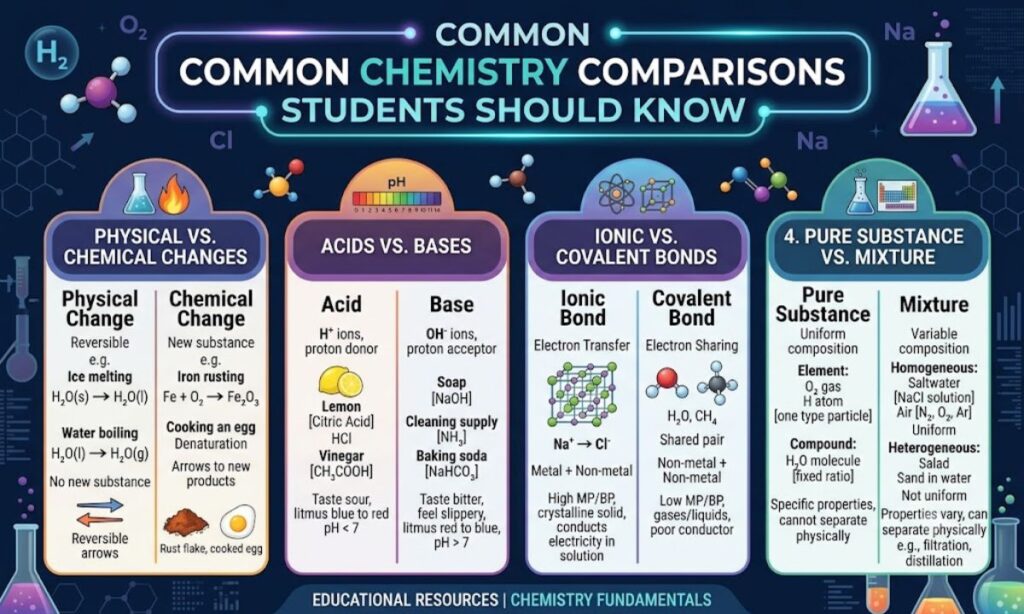
- Solution vs. Suspension — a solution is fully dissolved and uniform, while a suspension contains visible, undissolved particles
- Solute vs. Solvent — the solute is the substance being dissolved; the solvent is what does the dissolving
- Strong Acid vs. Weak Acid — strong acids dissociate completely, weak acids only partially
Biology and Earth Science S-Words Worth Knowing
Beyond the categories above, these S-words appear frequently in biology and earth science curricula:
- Stimulus – Anything that triggers a response in an organism (e.g., light causing a pupil to constrict)
- Substrate – The base material a reaction or organism acts upon, such as an enzyme’s substrate
- Stem Cell – An unspecialized cell capable of developing into different cell types
- Seismology – The scientific study of earthquakes and how seismic waves travel through the Earth
- Sustainability – Meeting present resource needs without compromising future generations’ ability to do the same
How to Learn and Remember Science Words Faster

Memorizing a long vocabulary list can feel overwhelming, but a few simple strategies make it easier:
- Group words by subject — studying chemistry terms separately from physics terms reduces confusion.
- Use flashcards — write the word on one side and the definition plus an example on the other.
- Connect words to real life — linking “solidification” to freezing water makes the term easier to recall.
- Teach it to someone else — explaining a term out loud strengthens memory far more than silent reading.
- Break down word roots — recognizing prefixes like syn- (together) or super- (above) helps you guess the meaning of new terms.
Final Words
Science words that start with S span an incredible range — from the solar energy warming our planet to the stereochemistry shaping how medicines work in our bodies. Building familiarity with these terms, whether general, physics-based, or chemistry-focused, strengthens both classroom performance and everyday scientific literacy. Use the tables above as a quick-reference glossary, and revisit them regularly to make these words part of your permanent vocabulary.
Frequently Asked Questions
What are some easy science words that start with S?
Simple examples include sun, seed, soil, sound, and solution — words commonly used in early science education.
What is the difference between a solution and a suspension?
A solution is a completely dissolved, uniform mixture, while a suspension contains visible particles that eventually settle.
Why do so many scientific terms start with S?
Many science words originate from Latin and Greek roots using prefixes like sub-, super-, and syn-, which naturally increases S-based vocabulary.