
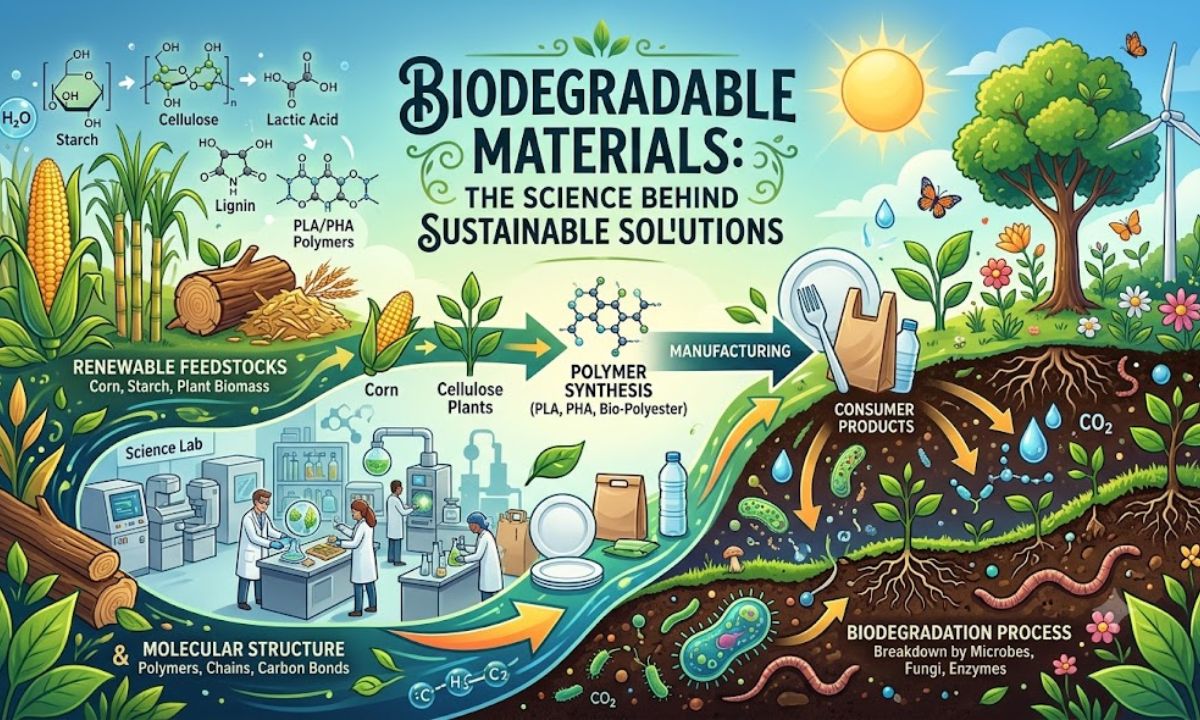
Picture a plastic bottle tossed into the ocean. It can linger for centuries, breaking into microplastics that harm marine life long after anyone remembers throwing it away. Now picture an alternative: a material designed to return to the earth naturally, leaving behind only water, carbon dioxide, and trace minerals.
That’s the promise of biodegradable materials. But behind the marketing buzzwords lies real science — a mix of biology, chemistry, and engineering that determines whether something truly breaks down or just sits in a landfill wearing a “green” label.
This guide breaks down how biodegradation actually works, the science fields that study it, and a full list of science vocabulary (from Biology to Buffer Solution) that helps make sense of the sustainability conversation.
What Are Biodegradable Materials?
Biodegradable materials are substances that microorganisms — bacteria, fungi, and algae — can break down into natural elements like water, carbon dioxide, and biomass. Unlike conventional plastics, which can persist for hundreds of years, these materials are designed to re-enter natural cycles.
Common examples include:
- Plant-based plastics (PLA) – made from corn starch or sugarcane
- Natural fibers – cotton, jute, hemp, wool
- Paper and cardboard – derived from wood pulp
- Compostable packaging – often blended from agricultural waste
How Biodegradation Actually Works
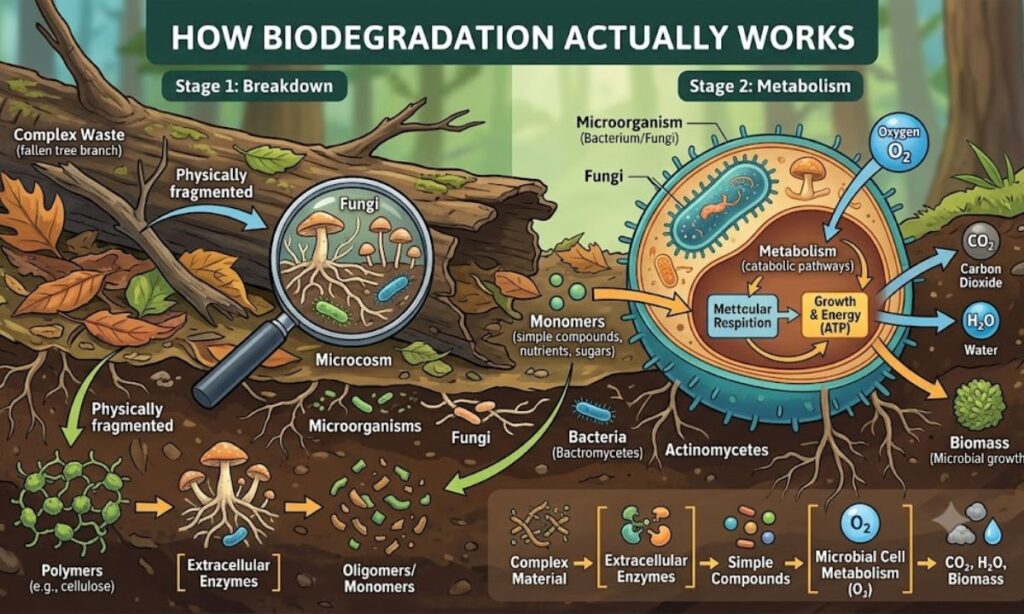
Biodegradation isn’t a single event — it’s a multi-step biological process:
- Colonization – Microorganisms attach to the material’s surface.
- Enzymatic breakdown – Microbes secrete enzymes that break polymer chains into smaller fragments.
- Assimilation – Microorganisms absorb these fragments as a food/energy source.
- Mineralization – The material fully converts into water, CO₂ (or methane, without oxygen), and biomass.
Degradation speed depends heavily on environment — temperature, moisture, oxygen levels, and the specific microbial community all matter. A material that composts in weeks in an industrial facility might take years in a landfill with little oxygen or microbial activity.
Biodegradable vs. Compostable vs. Recyclable
These terms get mixed up constantly. Here’s a clear comparison:
| Term | What It Means | Timeframe | Conditions Needed |
| Biodegradable | Breaks down via microorganisms | Weeks to years | Varies widely |
| Compostable | Breaks down into nutrient-rich soil | Weeks to months | Specific heat, moisture, oxygen |
| Recyclable | Reprocessed into new products | Depends on collection | Requires recycling infrastructure |
Compostable materials are always biodegradable, but not all biodegradable materials are compostable — some need very specific industrial conditions to break down cleanly.
The Science Fields Behind Sustainable Materials
Understanding biodegradable materials means drawing from several interconnected sciences. Below is a full breakdown of relevant “B” science terms, plus related vocabulary across other letters.
Biology
Biology is the study of living organisms and their processes. It underpins biodegradation because the entire process depends on living microbes — bacteria, fungi, and enzymes — interacting with material at a cellular level.
Biochemistry
Biochemistry examines the chemical reactions happening inside living organisms. In biodegradation, biochemistry explains how enzymes break down polymer bonds in materials like PLA or cellulose into simpler compounds microbes can consume.
Biotechnology
applies biological systems and organisms to develop new technologies and pBiotechnology roducts. It’s the field responsible for engineering bio-based plastics, genetically optimized enzymes, and lab-grown materials designed to biodegrade efficiently.
Biodiversity
Biodiversity refers to the variety of life forms within an ecosystem. Rich microbial biodiversity in soil or compost accelerates biodegradation because more microbial species means more enzyme pathways available to break down different materials.
Behavioral Science
Behavioral science studies how people make decisions and form habits. It plays a role in sustainability by explaining why consumers choose (or ignore) eco-friendly products and how labeling influences purchasing behavior.
Buffer Solution
A buffer solution is a chemical mixture that resists changes in pH when small amounts of acid or base are added. In biodegradation research, buffer solutions are used in labs to maintain stable conditions while testing how materials break down under controlled acidity levels.
Science Words That Start With B (By Grade Level)
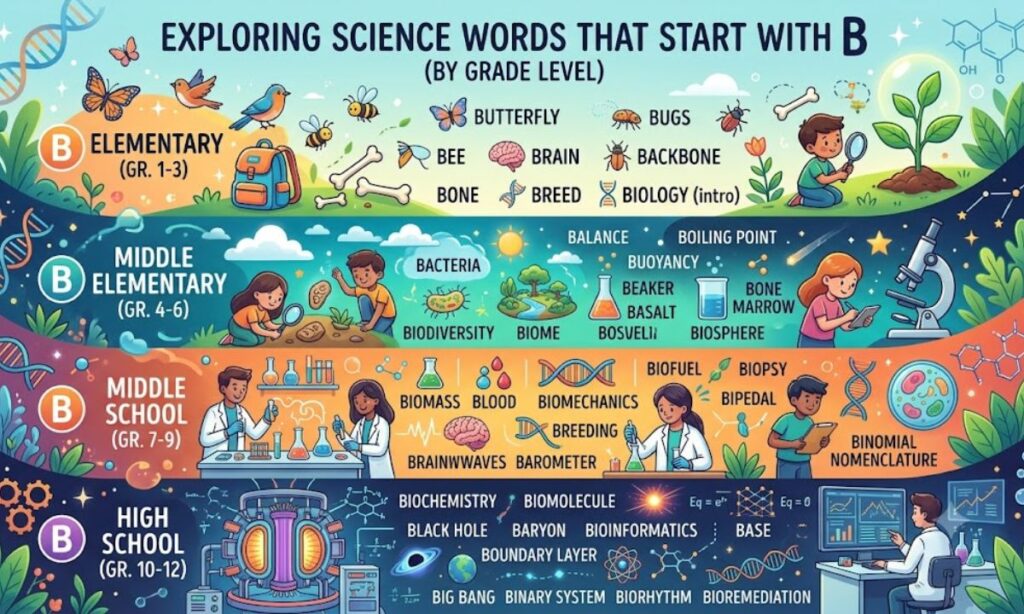
Vocabulary complexity naturally increases with grade level. Here’s a simple reference table.
| Grade Level | Example Words |
| 6th Grade | Bacteria, Biome, Boiling point, Barometer, Buoyancy |
| 8th Grade | Biosphere, Biomass, Bond (chemical), Biodegradable, Biotic factor |
Science Words That Start With B (6th Grade)
At this level, students typically learn foundational terms like bacteria, biome, buoyancy, barometer, and boiling point — words tied to everyday observations of nature and simple physics.
Science Words That Start With B (8th Grade)
Middle-school science introduces more technical vocabulary such as biosphere, biomass, biotic factor, biodegradable, and chemical bond — concepts that connect biology with chemistry and environmental science.
More Science Vocabulary Worth Knowing
To fully understand sustainability topics, it helps to expand beyond just “B” words.
Science Words That Start With A
Words like atom, atmosphere, adaptation, acid, and alloy frequently appear alongside biodegradability discussions, especially when explaining chemical reactions or environmental layers.
Science Words That Start With D
Terms such as decomposition, density, DNA, diffusion, and dormancy are directly relevant — decomposition, in particular, is essentially another name for the natural breakdown process biodegradable materials rely on.
Science Words That Start With E
Key terms include ecosystem, enzyme, erosion, evaporation, and energy. Enzymes especially matter here, since they’re the biological “tools” microorganisms use to break down biodegradable polymers.
Biology Words That Start With B
Within biology specifically, common “B” terms include bacteria, biome, biosphere, biodiversity, biosynthesis, and bioaccumulation — all relevant when studying how living systems interact with man-made and natural materials.
Why Biodegradable Materials Matter for Sustainability
Biodegradable materials offer several concrete environmental advantages:
- Reduced landfill accumulation – organic materials break down instead of persisting for centuries
- Lower microplastic pollution – natural polymers don’t fragment into the same harmful particles as conventional plastic
- Support for circular economy models – materials return to natural cycles rather than becoming permanent waste
- Reduced fossil fuel dependency – many biodegradable plastics are derived from renewable crops like corn and sugarcane
However, these benefits only materialize under the right conditions. A biodegradable product sent to a landfill without oxygen or the correct microbial environment may barely degrade faster than conventional plastic — which is why disposal method matters just as much as material choice.
Common Misconceptions About Biodegradable Materials
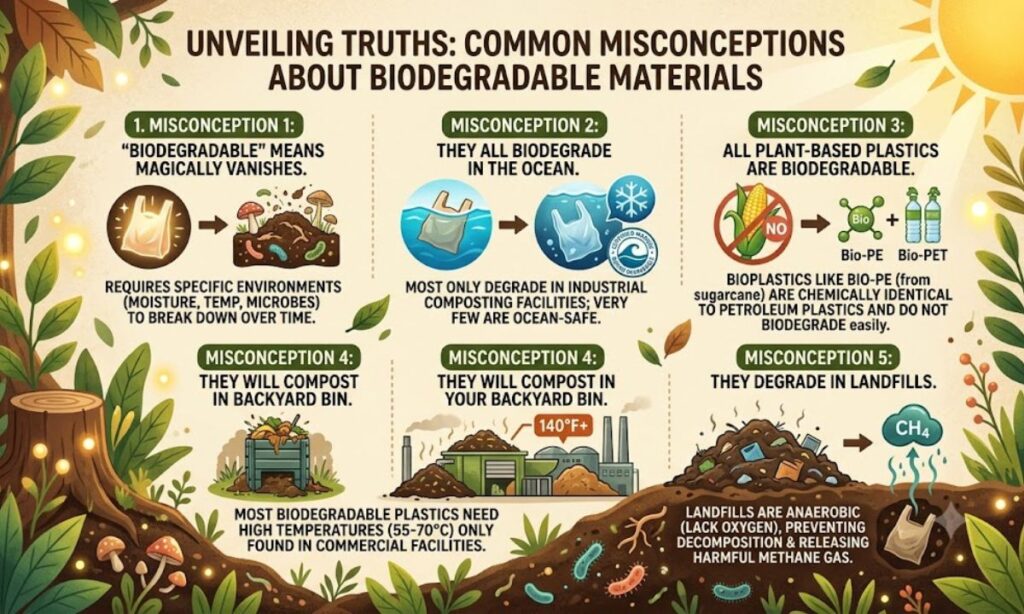
- Not all biodegradable materials are compostable at home. Many require industrial “Biodegradable” doesn’t always mean “fast.” Some materials take years without the right conditions.composting facilities.
- Biodegradable doesn’t automatically mean non-toxic. Byproducts still depend on the material’s chemical makeup.
Final Words
Biodegradable materials sit at the intersection of biology, chemistry, and environmental engineering. They’re not a magic fix for pollution, but when produced and disposed of correctly, they offer a genuinely lower-impact alternative to conventional plastics. Understanding the science — from enzymatic breakdown to the biotechnology behind bioplastics — helps separate real sustainability progress from surface-level greenwashing.
As research in biotechnology and materials science continues advancing, biodegradable solutions are likely to become more efficient, more accessible, and more capable of matching the performance of traditional plastics without the long-term environmental cost.
frequently asked questions
What makes a material biodegradable?
A material is biodegradable if microorganisms like bacteria and fungi can break it down into natural substances such as water, CO₂, and biomass.
Is biodegradable the same as compostable?
No. Compostable materials are always biodegradable, but they specifically break down into nutrient-rich soil under controlled conditions, unlike general biodegradable materials.
How long do biodegradable materials take to break down?
It varies widely — from a few weeks in ideal composting conditions to several years in landfills lacking oxygen and microbial activity.
What is the role of biotechnology in biodegradable materials?
Biotechnology helps engineer bio-based plastics and optimized enzymes that improve how efficiently materials break down naturally.
Are biodegradable plastics better for the environment than regular plastics?
Generally yes, especially regarding microplastic pollution and fossil fuel dependency, but their benefit depends on proper disposal and processing conditions.