
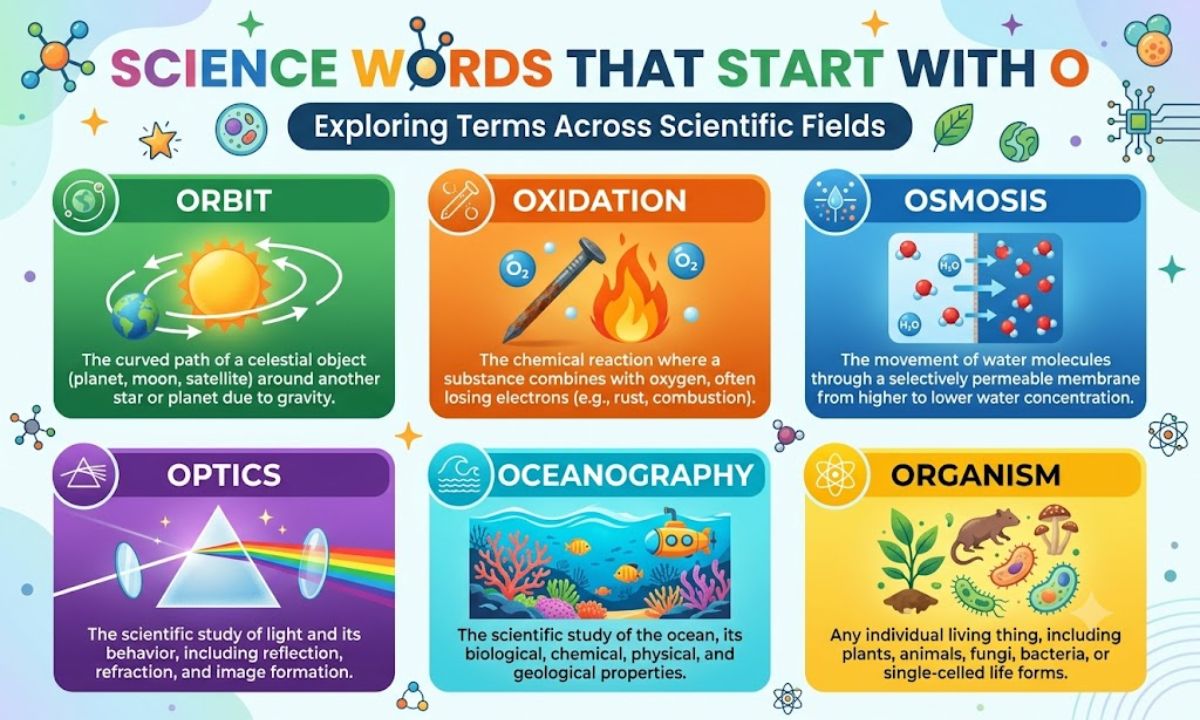
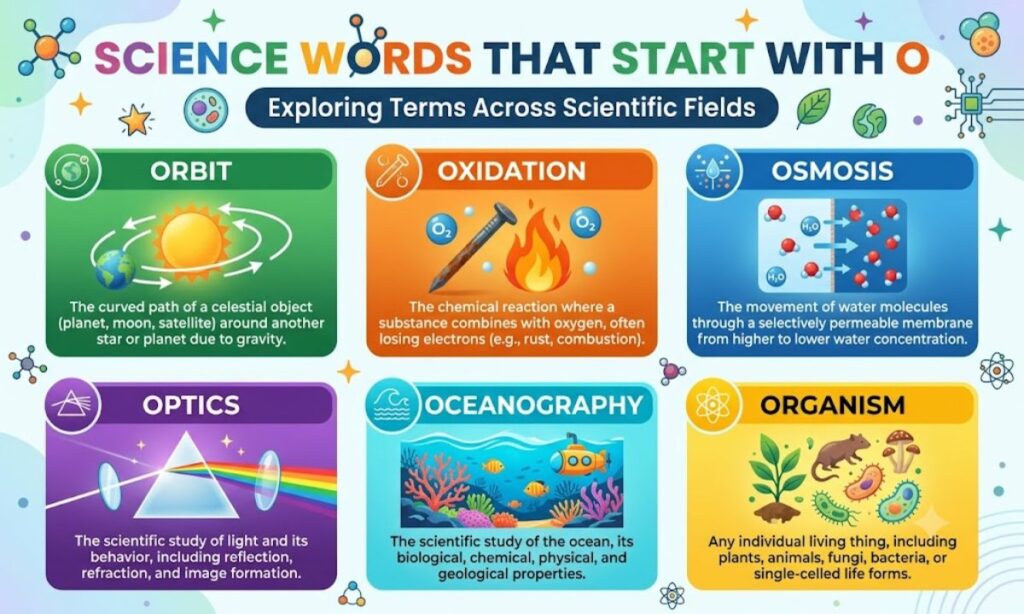
Science has its own language, and every letter of the alphabet unlocks a new set of ideas. The letter O is packed with terms you’ll run into constantly — in biology class, chemistry labs, astronomy lessons, and even everyday news about the environment. From the air you breathe to the way cells stay balanced, “O” words explain some of the most fundamental processes in nature.
In this guide, you’ll find a clear, easy-to-follow list of science words that start with O, complete with simple definitions and real-world examples. Whether you’re a student prepping for an exam, a parent helping with homework, or just curious about scientific vocabulary, this article breaks everything down in plain language.
List of Science Words That Start With O
Here’s a quick-reference table covering the most important O-words in science, along with their meaning and a simple example.
| Word | Simple Definition | Example |
| Oxygen | A gas essential for breathing and combustion | Humans need oxygen to survive and produce energy in cells |
| Osmosis | Movement of water through a semi-permeable membrane | Plant roots absorb water through osmosis |
| Organism | Any living thing, from bacteria to humans | A tree, a fish, and a bacterium are all organisms |
| Oxidation | A chemical reaction where a substance loses electrons | Rust forms on iron through oxidation |
| Ozone | A molecule made of three oxygen atoms | The ozone layer shields Earth from harmful UV rays |
| Oceanography | The scientific study of oceans | Oceanographers track currents, tides, and marine life |
| Oscillation | Repeated back-and-forth movement around a fixed point | A swinging pendulum shows oscillation |
Let’s look at each of these in more detail.
Oxygen
Oxygen is a chemical element with the symbol O and atomic number 8. It makes up roughly 21% of Earth’s atmosphere and is essential for nearly every living organism. Without it, cells can’t produce the energy needed to function.
Example: When you inhale, oxygen travels from your lungs into your bloodstream, where it’s carried to cells throughout your body.
Oxygen also plays a role in combustion (helping things burn) and in oxidation reactions, which is why it connects closely to several other terms on this list.
Osmosis
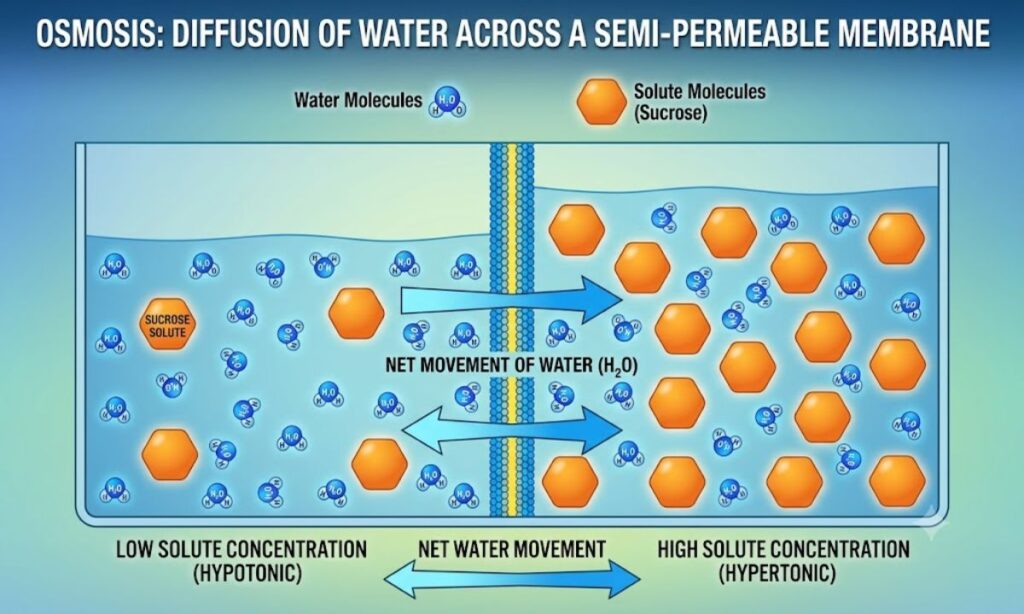
Osmosis is the process by which water molecules move across a semi-permeable membrane, flowing from an area of low solute concentration to an area of high solute concentration. It’s a key concept in biology, especially when studying how cells maintain balance.
Example: A plant’s roots pull water from the soil through osmosis, keeping the plant hydrated and upright.
Organism
An organism is any living thing capable of carrying out life processes such as growth, reproduction, and response to its environment. Organisms range from single-celled bacteria to complex multicellular life like humans and whales.
Example: A mushroom, a housefly, and a human being are all classified as organisms.
Oxidation
Oxidation is a chemical reaction in which a substance loses electrons, often resulting in a change in its properties. It’s one of the most common reactions in both nature and industry.
Example: When iron is exposed to moisture and air, it undergoes oxidation and forms rust.
Oxidation is closely tied to reduction (the opposite process), and together they’re often taught as “redox” reactions in chemistry.
Ozone
Ozone is a molecule composed of three oxygen atoms (O₃). It exists in a protective layer high in Earth’s atmosphere, where it absorbs most of the sun’s harmful ultraviolet radiation.
Example: The ozone layer prevents excessive UV exposure, which helps protect humans from skin damage and reduces risks to ecosystems.
At ground level, however, ozone can act as a pollutant, which is why scientists distinguish between “good” ozone (in the stratosphere) and “bad” ozone (near the surface).
Oceanography
Oceanography is the branch of science dedicated to studying the ocean — its currents, tides, marine organisms, chemical composition, and geological features. It combines elements of biology, chemistry, geology, and physics.
Example: Oceanographers study coral reefs to understand how rising sea temperatures affect marine ecosystems.
Oscillation
Oscillation refers to a repetitive back-and-forth or up-and-down movement around a central or equilibrium point. This concept appears frequently in physics, especially in the study of waves and energy.
Example: A swinging pendulum or a vibrating guitar string both demonstrate oscillation.
Understanding oscillation helps explain concepts like sound waves, electrical currents, and even the motion of planets in some contexts.
More Science Words That Start With O
Beyond the core terms above, here are a few more useful O-words you might encounter in textbooks or classroom discussions:
- Orbit – The curved path an object takes around another object in space
- Organ – A structure made of tissues that performs a specific function (like the heart or lungs)
- Observation – The act of gathering information using the senses or instruments
- Optics – The branch of physics that studies light and vision
- Ovary – A reproductive organ that produces eggs in females
- Offspring – The young produced by living organisms
- Outlier – A data point that differs significantly from other observations
- Organic – Relating to living matter, or compounds containing carbon
Science Words That Start With O for Kids
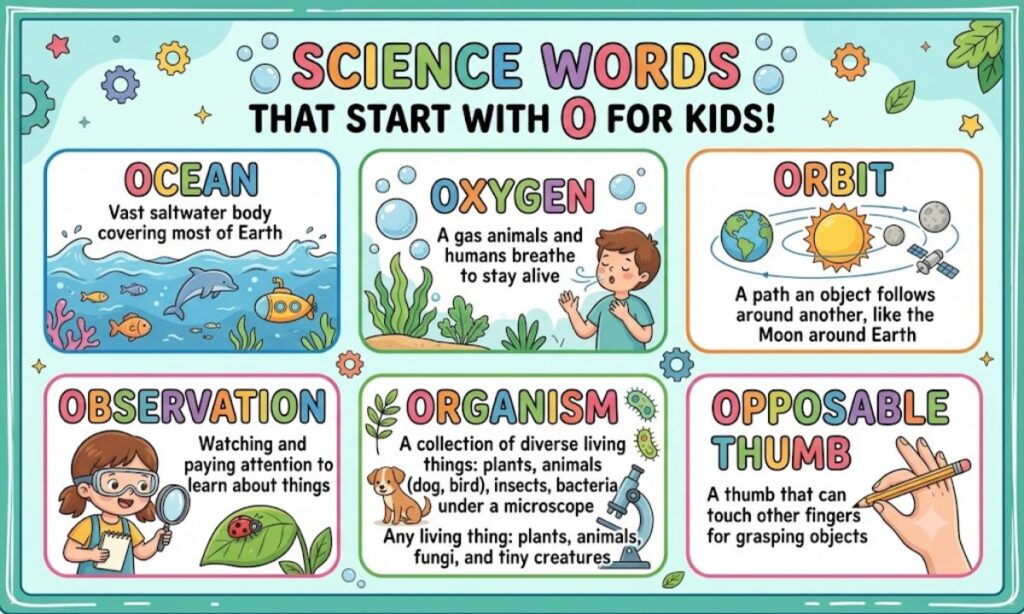
Younger learners benefit from simpler, more relatable examples. Here are some beginner-friendly O-words:
- Oxygen – The air we breathe to stay alive
- Ocean – A huge body of salt water
- Orbit – The path Earth takes around the Sun
- Organism – Any living thing, big or small
- Observation – Watching something closely to learn about it
Science Words That Start With O for 8th Grade
By 8th grade, students typically encounter more advanced vocabulary tied to specific subjects like chemistry and physics:
- Oxidation
- Osmosis
- Oscillation
- Organic Chemistry
- Order of Magnitude
These terms usually connect to lab experiments and deeper conceptual understanding, rather than simple definitions.
Biology Words That Start With O
Since biology is one of the richest sources of O-vocabulary, here’s a shortlist focused specifically on that subject:
- Organism
- Osmosis
- Organ
- Ovary
- Offspring
- Ontogeny (the development of an organism from fertilization to maturity)
Related Vocabulary: Nearby Letters
If you’re building out a full science glossary, you may also want to explore:
- Science words that start with N — covers terms like nucleus, nutrient, and neutron
- Science words that start with P — includes photosynthesis, physics, and proton
- Science words that start with L — features terms like lipid, larva, and luminosity
Learning vocabulary letter by letter is a simple, structured way to expand your scientific knowledge over time.
Final Words
Science words that start with O cover an incredible range of topics — from the air we breathe to the movement of ocean currents and the swing of a pendulum. Terms like oxygen, osmosis, organism, oxidation, ozone, oceanography, and oscillation aren’t just vocabulary to memorize; they represent real processes happening around us every day.
Whether you’re studying for a test, helping a child with homework, or simply curious about how the world works, understanding these terms gives you a stronger foundation in biology, chemistry, and physics. Keep building your list one letter at a time, and scientific concepts will start to feel a lot more familiar.
Frequently Asked Questions
What are some easy science words that start with O?
Oxygen, ocean, orbit, organism, and observation are all simple, beginner-friendly examples.
What is the most important O-word in science?
Oxygen is widely considered the most essential, since it’s required for respiration and energy production in nearly all living things.
What’s the difference between osmosis and oxidation?
Osmosis is the movement of water across a membrane, while oxidation is a chemical reaction involving the loss of electrons.
Why does the ozone layer matter?
It absorbs most of the sun’s harmful UV radiation, protecting living organisms from excessive exposure.
What subject uses the most O-words?
Biology and chemistry use the widest range of O-terms, though physics and earth science contribute several key ones too.