
Science is full of vocabulary that sounds intimidating at first but becomes second nature once you see it in action. The letter “V” alone carries some of the most important terms in physics, chemistry, and biology — words you’ll run into in a classroom, a lab, or even a casual conversation about how the world works.
This guide breaks down the most useful science words that start with V, explains what each one means in plain language, and shows you exactly how it’s used in real life. Whether you’re a student prepping for an exam or just curious about scientific terminology, you’ll walk away with a clear, practical understanding of every word on this list.
List Of Science Words That Start With V
Here’s a quick overview of the core terms covered in this article:
| Word | Field | Quick Meaning |
|---|---|---|
| Velocity | Physics | Speed with direction |
| Volume | Physics/Chemistry | Amount of space an object occupies |
| Vibration | Physics | Rapid back-and-forth motion |
| Voltage | Physics | Electric potential difference |
| Vacuum | Physics | Space with little to no matter |
| Virus | Biology | Microscopic infectious agent |
| Vaccine | Biology/Medicine | Substance that builds immunity |
| Viscosity | Chemistry/Physics | A fluid’s resistance to flow |
| Vaporization | Chemistry | Liquid turning into gas |
| Valence | Chemistry | An atom’s bonding capacity |
| Vertebrate | Biology | Animal with a backbo |
Velocity

Velocity refers to how fast an object moves and the direction it’s moving in. This makes it different from plain “speed,” which only tells you how fast something is going.
- Example: A car traveling 60 km/h north has a different velocity than one traveling 60 km/h south, even though their speeds are identical.
- Where you’ll see it: Physics problems involving motion, sports analytics, vehicle design, and space travel calculations.
Volume
Volume is the amount of three-dimensional space an object or substance occupies. It’s measured in units like liters, cubic meters, or milliliters.
- Example: A water bottle holding 500 ml has a volume of 500 ml, regardless of its shape.
- Where you’ll see it: Cooking measurements, chemistry experiments, packaging design, and geometry.
Vibration
Vibration is a rapid, repetitive back-and-forth movement around a fixed point. It’s the reason we hear sound at all.
- Example: Plucking a guitar string causes it to vibrate, which pushes air molecules and creates the sound waves you hear.
- Where you’ll see it: Acoustics, engineering diagnostics (detecting worn-out machinery), and smartphone alerts.
Voltage
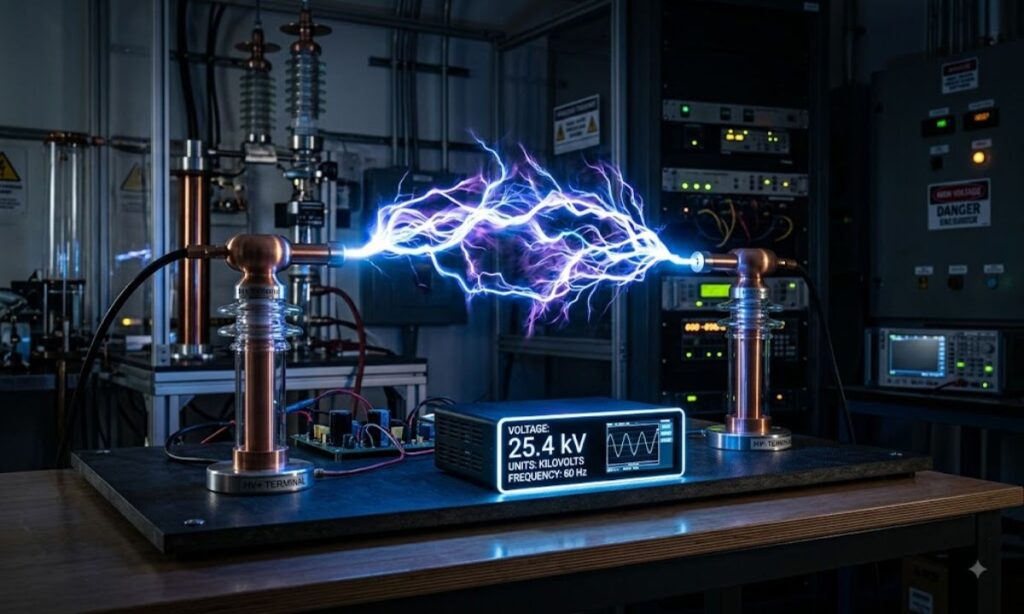
Voltage is the difference in electric potential between two points, essentially the “push” that drives electric current through a circuit.
- Example: A standard AA battery provides about 1.5 volts to power small devices like remote controls.
- Where you’ll see it: Electronics, electrical engineering, and everyday appliances.
Vacuum
A vacuum is a space that contains little to no matter, meaning air or gas pressure is extremely low or completely absent.
- Example: Outer space is close to a perfect vacuum, which is why sound can’t travel there.
- Where you’ll see it: Space science, vacuum-sealed food packaging, and industrial manufacturing.
Virus
A virus is a microscopic infectious agent that can only reproduce by invading a living host cell. Viruses are technically not considered fully “alive” on their own.
- Example: The influenza virus spreads between people and causes seasonal flu.
- Where you’ll see it: Medicine, biology, epidemiology, and public health discussions.
Vaccine
A vaccine is a substance introduced into the body to trigger an immune response, helping the body recognize and fight a specific disease without causing the illness itself.
- Example: The measles vaccine trains the immune system to recognize the measles virus before an actual infection occurs.
- Where you’ll see it: Healthcare, immunology, and preventive medicine.
Viscosity
Viscosity describes how resistant a fluid is to flowing. Thick liquids have high viscosity; thin liquids have low viscosity.
- Example: Honey has a much higher viscosity than water, which is why it pours so slowly.
- Where you’ll see it: Engine oil ratings, food science, and industrial fluid engineering.
Vaporization
Vaporization is the process of a liquid turning into a gas, either through boiling or gradual evaporation.
- Example: Water vaporizes into steam when heated to 100°C at sea level.
- Where you’ll see it: Chemistry labs, weather systems, and cooking.
Valence
Valence refers to an atom’s capacity to bond with other atoms, based on the number of electrons in its outermost shell.
- Example: Oxygen has a valence of 2, meaning it typically forms two bonds, as seen in water (H₂O).
- Where you’ll see it: Chemistry education, molecular structure analysis, and material science.
Vertebrate

A vertebrate is any animal that has a backbone or spinal column. This includes mammals, birds, reptiles, amphibians, and fish.
- Example: Humans, dogs, and eagles are all vertebrates because they have an internal skeleton with a spine.
- Where you’ll see it: Biology classification (taxonomy), zoology, and evolutionary science.
Why These Words Matter
Learning science vocabulary isn’t just about memorizing definitions for a test. These “V” words show up across multiple disciplines and help connect ideas:
- Physics terms like velocity, vibration, voltage, and vacuum describe how energy and motion behave in the physical world.
- Chemistry terms like viscosity, vaporization, and valence explain how substances interact and change state.
- Biology terms like virus, vaccine, and vertebrate describe living systems and how they function or defend themselves.
Understanding these connections makes it easier to grasp more advanced topics later, since many scientific concepts build directly on this foundational vocabulary.
A Few Tips to Remember These Words
- Link each word to a real-life example. Connect “vaccine” to a doctor’s visit or “vibration” to your phone buzzing.
- Group words by subject. Keep physics terms (velocity, voltage, vacuum) separate from biology terms (virus, vaccine, vertebrate) in your notes.
- Use flashcards. Write the word on one side and a one-line definition plus example on the other.
- Watch short videos. Seeing vaporization or vibration in action helps the concept stick better than reading alone.
Final Words
Science vocabulary starting with “V” spans an impressively wide range, from the physics of motion and electricity to the biology of viruses and vaccines. Each word carries real, practical meaning that shows up in classrooms, laboratories, and everyday life. By understanding terms like velocity, viscosity, valence, and vertebrate, you build a stronger foundation for exploring more complex scientific ideas down the road. Keep this list handy as a quick reference whenever you come across one of these words in your studies.
Frequently Asked Questions
What are the most common science words that start with V?
Velocity, volume, vibration, voltage, and virus are among the most commonly used science words starting with V.
What is the easiest science word that starts with V?
“Vapor” is one of the simplest, referring to a substance in its gas form, like steam.
Is “vaccine” a biology or medical term?
It falls under both — vaccines are studied in immunology (biology) and used clinically in medicine.
What’s the difference between velocity and speed?
Speed only measures how fast something moves, while velocity includes both speed and direction.
Why is valence important in chemistry?
Valence determines how many bonds an atom can form, which helps predict how molecules are built.