
TLDR (or TL;DR) stands for “Too Long; Didn’t Read.” It’s an internet initialism used to either summarize a lengthy piece of text in a few sentences or to comment that a post, email, or article is too long to read in full. Today it appears everywhere from Reddit threads to corporate emails to AI chat tools, and it’s even recognized by Merriam-Webster’s Dictionary.
If you’ve ever scrolled to the bottom of a long article or email and spotted a short summary line, you’ve already seen TLDR in action. Let’s break down exactly what it means, where it came from, and how to use it correctly.
TLDR Full Form
The full form of TLDR is “Too Long; Didn’t Read.”
- TL = Too Long
- DR = Didn’t Read
It’s technically classified as an initialism rather than an acronym, because each letter is pronounced individually (T-L-D-R) instead of being read as one word. Some style guides insert a semicolon (TL;DR), while casual internet usage often drops it entirely (TLDR). Both spellings mean exactly the same thing, and both are widely accepted.
You’ll usually find TLDR used in one of two ways:
- As a summary marker — placed at the start or end of a long piece of writing to give readers the short version.
- As a comment or reaction — used by a reader to say a post was too long to bother finishing.
Where Did TLDR Come From? (Origin & History)
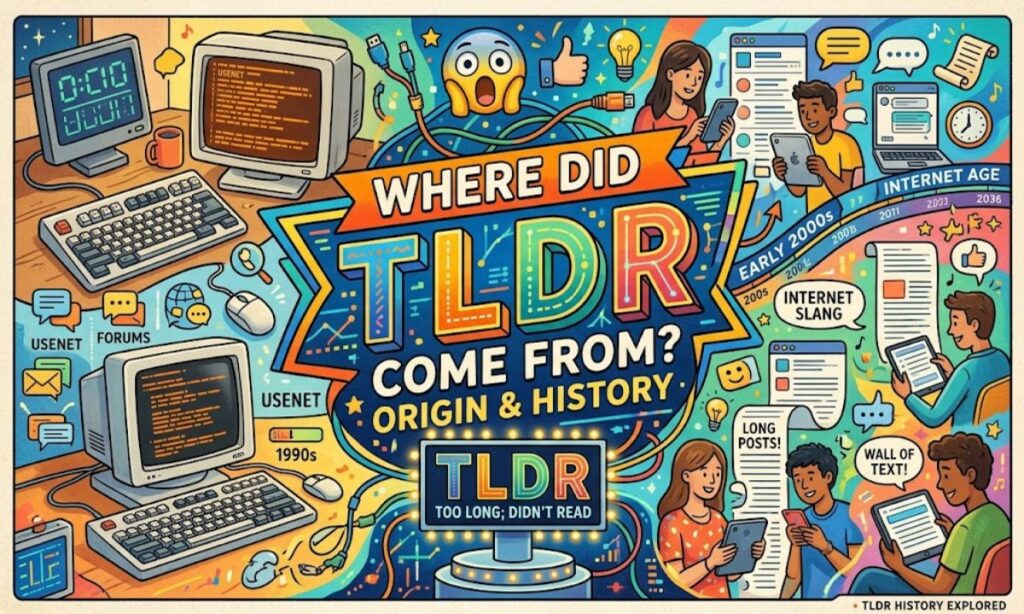
TLDR’s roots trace back to early 2000s internet forum culture, long before social media as we know it existed today.
- The earliest documented use of “TL;DR” appears to date back to around 2002–2003, showing up on discussion boards and being added to Urban Dictionary in January 2003.
- It grew popular on forums like early internet message boards and imageboards, where users would post extremely long rants, stories, or arguments — and other users would reply “TL;DR” to mock or dismiss the length.
- Over time, the phrase shifted from being purely dismissive to genuinely helpful. Instead of just mocking long posts, people began adding their own TL;DR summary at the top of long content, so readers could get the gist without reading everything.
- In 2018, Merriam-Webster officially added “TL;DR” to its dictionary, cementing it as a legitimate part of modern English rather than just internet slang.
- Google search interest in the term has steadily climbed since the mid-2000s, reflecting how mainstream the phrase has become across blogs, news outlets, and workplace communication.
In short: TLDR was born as internet shorthand for impatience, but it evolved into a practical writing tool that improves readability for everyone.
TLDR Meaning in Corporate Settings
In workplace and corporate communication, TLDR is used constructively rather than sarcastically. Busy professionals use it to:
- Summarize long emails at the top so recipients grasp the key point instantly
- Condense meeting notes or project updates into a few bullet points
- Flag the “bottom line” of a report before diving into details
A corporate TLDR usually looks something like: “TL;DR: Project launch is delayed by two weeks due to vendor issues; no budget impact.” It’s become a common way to respect colleagues’ time in fast-paced business environments.
TLDR Meaning on ChatGPT
When people ask ChatGPT (or similar AI chat tools) to “TLDR this,” they’re asking the AI to condense a long article, document, or conversation into a short, digestible summary. This has become one of the most common everyday AI prompts, since AI models are naturally good at compressing information. Typing “TLDR” or “give me a TL;DR” is now a standard shortcut for requesting a quick summary from an AI assistant.
TLDR Meaning on Urban Dictionary
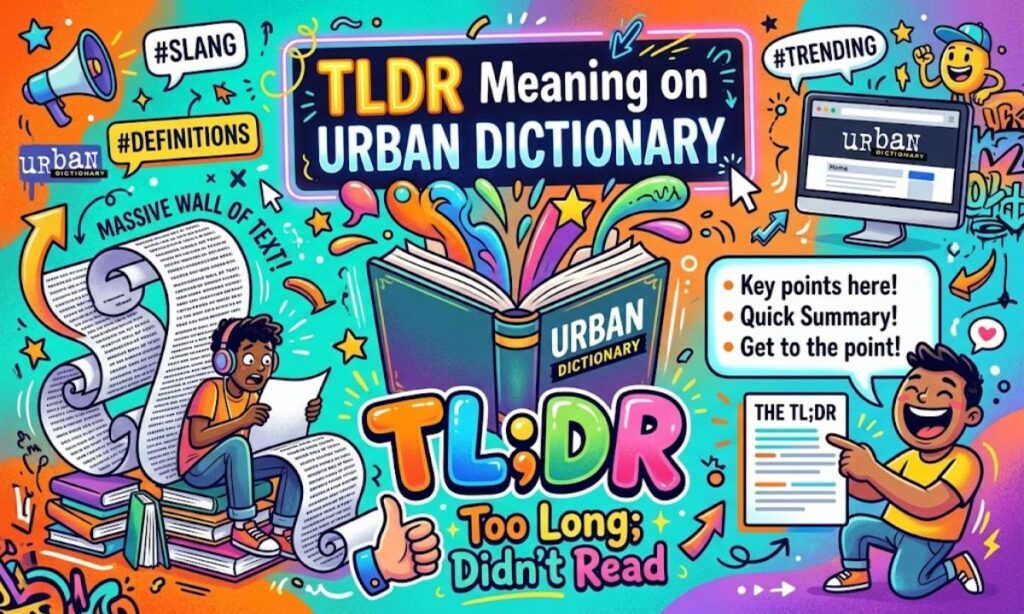
Urban Dictionary’s earliest definitions frame TLDR mainly as a dismissive or humorous response to overly long forum posts — essentially internet slang for “this was way too long, I skipped it.” This is where the term first went “official” online, and many casual, meme-style definitions still lean toward this snarkier tone.
TLDR Meaning on Reddit
Reddit is one of the platforms most responsible for popularizing TLDR in modern usage. On Reddit, TLDR typically appears in two forms:
- Original poster (OP) TLDR — a short summary added at the end of a long post so readers can skip straight to the point.
- Commenter TLDR — a reply where someone summarizes a lengthy comment thread or article for others who don’t want to read everything.
Reddit’s community guidelines and etiquette often encourage posters to include a TLDR, especially in long-form subreddits, making it one of the most TLDR-friendly platforms online.
How to Write a Good TLDR
If you’re wondering how to write your own TLDR, keep these tips in mind:
- Keep it to 1–3 sentences maximum
- Lead with the main conclusion or key takeaway, not background details
- Avoid jargon — write it so someone with zero context understands it
- Place it either at the very top (for busy readers) or the very bottom (as a recap)
- Use bullet points if you’re summarizing multiple points at once
TLDR vs TL;DR — Is There a Difference in Spelling?
Many people wonder whether “TLDR” and “TL;DR” mean different things. They don’t — the meaning is identical. The only difference is punctuation and formality.
| Feature | TL;DR | TLDR |
| Meaning | Too Long; Didn’t Read | Too Long; Didn’t Read |
| Punctuation | Includes semicolon | No punctuation |
| Common usage | Formal writing, dictionaries, news articles | Casual chats, texts, forums, social media |
| Dictionary status | Recognized by Merriam-Webster | Treated as an accepted variant spelling |
| Tone | Slightly more polished | More informal and quick |
Both versions are grammatically acceptable, and search engines treat them as interchangeable. Use whichever fits your context — TL;DR for professional or edited writing, TLDR for quick, casual messages.
TLDR Examples
Here are some real-world style examples showing how TLDR is used in different contexts:
In an email:
“TL;DR: The client approved the new design, launch moves to next Monday, no further action needed from you.”
In a Reddit post:
“Long story short — TLDR: I quit my job after 5 years because my manager kept taking credit for my work.”
In a text message:
“omg that article was SO long, tldr someone please 😩”
In a business report:
“TL;DR: Q3 revenue is up 12%, marketing spend needs to be reduced by 8% next quarter.”
As a request for AI or a colleague:
“Can you TLDR this 10-page document for me before the meeting?”
In a product review:
“TLDR: Great sound quality, poor battery life, worth it only if you don’t need all-day use.”
These examples show how flexible TLDR is — it works as a noun (a summary), a verb (“to TLDR something”), or a standalone comment.
Conclusion
TLDR — short for “Too Long; Didn’t Read” — has grown from a snarky internet forum comment into one of the most useful pieces of digital shorthand in modern communication. Whether you’re skimming a Reddit thread, sending a quick work email, or asking ChatGPT to summarize a document, TLDR helps cut through information overload and get straight to the point. Both “TLDR” and “TL;DR” mean exactly the same thing, so feel free to use whichever spelling fits your tone. Next time you have something long to share, try adding your own TLDR at the top — your readers will thank you.
Frequently Asked Questions
What does TLDR stand for?
TLDR stands for “Too Long; Didn’t Read,” used to summarize or comment on lengthy text.
Is TLDR the same as TL;DR?
Yes, both spellings mean the same thing — the semicolon is just a stylistic choice.
Is TLDR a word in the dictionary?
Yes, Merriam-Webster officially added “TL;DR” to its dictionary in 2018.
Where did TLDR originate?
It likely originated on early 2000s internet forums, with recorded use dating back to around 2002–2003.
Is TLDR rude to use?
It can be seen as dismissive if used alone as a criticism, but it’s mostly used helpfully today as a summary.
How long should a TLDR be?
A good TLDR is usually just 1–3 short sentences summarizing the main point.
Can I use TLDR in professional emails?
Yes, it’s widely accepted in corporate communication to quickly convey the key takeaway.
Does ChatGPT understand “TLDR” as a command?
Yes, asking an AI to “TLDR” something is a common way to request a short summary of longer content.