
Scrolling through Instagram at midnight, seeing friends at a party you weren’t invited to, feeling a weird pinch in your chest — that’s FOMO. It’s one of the most-searched slang terms of the social media age, and almost everyone has felt it at least once. This guide breaks down what FOMO really means, where it came from, how to spot it in yourself, and simple ways to overcome it.
What Does FOMO Mean?
FOMO means the anxious feeling that other people are having a better, more exciting, or more fulfilling experience somewhere else while you’re missing it. It’s a mix of worry, regret, and restlessness, usually triggered by social media posts, group chats, or seeing others enjoy events, opportunities, or experiences without you.
FOMO Full Form
FOMO stands for Fear Of Missing Out.
It’s officially recognized as a real word — the Oxford English Dictionary added “FOMO” in 2013, defining it as anxiety over an interesting event happening elsewhere, often triggered by social media.
Where Did FOMO Come From? (Origin & History)
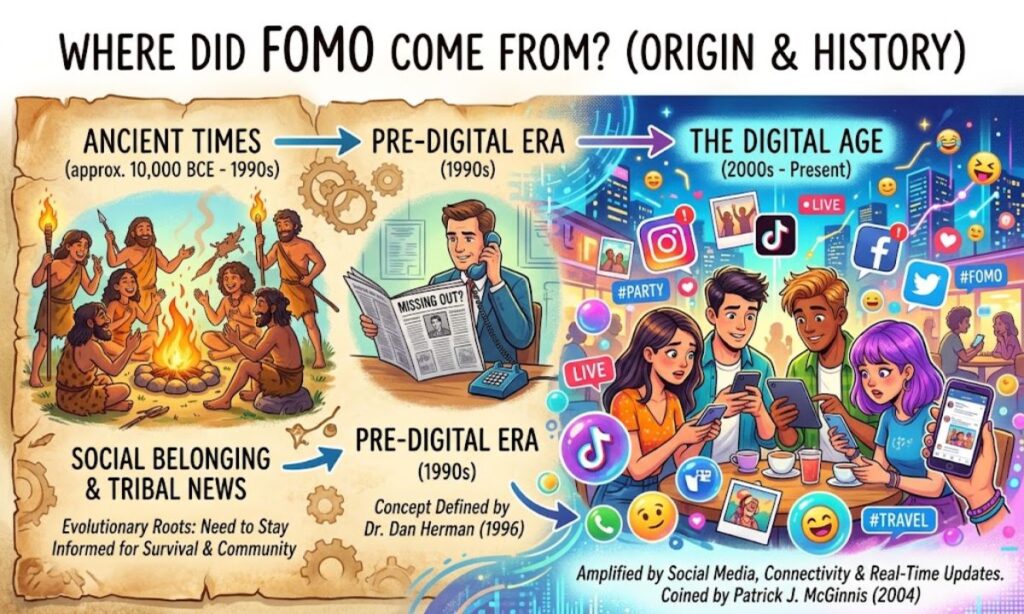
The term FOMO isn’t as new as most people think.
- Early 2000s: Dictionary.com traces the first recorded use of “FOMO” to the early 2000s, as internet and mobile culture started expanding.
- Academic roots: Marketing strategist Dr. Dan Herman is widely credited with first writing about the concept in a 1996 paper, long before it became internet slang.
- Social media boom: FOMO exploded in popularity once Facebook, Instagram, and Twitter made it normal to broadcast every party, vacation, and achievement in real time.
- Official recognition: In 2013, the Oxford English Dictionary formally added FOMO, cementing it as a legitimate word rather than just internet jargon.
Some sources also connect FOMO to an older, related phrase — “FOBO,” or fear of a better option — describing the constant search for a better choice instead of committing to the one in front of you. Over time, FOBO’s ideas blended into today’s FOMO.
Signs You’re Experiencing FOMO
FOMO shows up differently for different people, but a few patterns are common.
Emotional signs:
- Feeling anxious, sad, or restless after scrolling social media
- Comparing your life to others’ highlight reels
- Regret over declining an invite, even if you didn’t want to go
- A nagging sense that you’re “falling behind” in life
Behavioral signs:
- Constantly checking your phone for updates
- Saying yes to plans out of obligation, not desire
- Struggling to enjoy the present moment because you’re wondering what else is happening
- Overspending on events, trips, or trends just to “keep up”
If several of these sound familiar, you’re likely dealing with FOMO in some form.
FOMO Examples in Real Life
FOMO doesn’t just live on Instagram — it shows up across daily life.
| Area | Example |
| Social Media | Seeing friends’ vacation photos and feeling anxious that your life looks “boring” by comparison |
| Work | Skipping a break because you’re worried you’ll miss an important message or decision |
| School | Joining every club or event out of fear of being left out, even without real interest |
| Relationships | Feeling uneasy when a partner spends time with others, worrying you’re being replaced |
| Shopping | Buying a limited-time deal only because it feels like it will “sell out,” not because you need it |
| Finance | Jumping into a trending stock or crypto purchase because everyone else seems to be profiting |
These examples show that FOMO isn’t only about parties — it touches money, relationships, and everyday decisions too.
FOMO vs JOMO (Joy of Missing Out)
JOMO is the direct opposite of FOMO. Instead of anxiety over missing something, JOMO is the calm, contentment, and relief that comes from choosing not to participate — and being okay with it.
| FOMO | JOMO | |
| Full form | Fear Of Missing Out | Joy Of Missing Out |
| Core feeling | Anxiety, regret, restlessness | Peace, relief, contentment |
| Trigger | Comparing yourself to others online | Choosing your own priorities |
| Effect on wellbeing | Can increase stress and burnout | Often improves focus and mental health |
Learning to shift from FOMO to JOMO is often the real goal behind most advice on overcoming FOMO.
How to Overcome FOMO — 5 Practical Tips
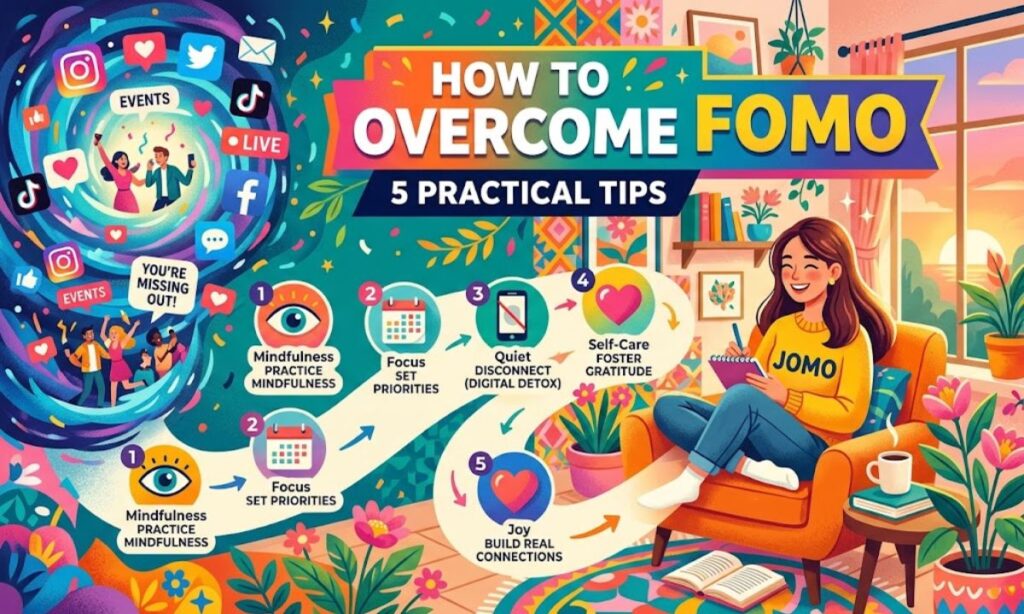
- Limit social media time. Set daily screen-time limits or scheduled “no-scroll” hours so you’re not constantly comparing your life to curated posts.
- Practice gratitude. Spend a minute each day noting what’s going well in your own life instead of measuring it against someone else’s highlight reel.
- Focus on your own goals. Redirect energy toward your personal priorities rather than chasing every trend, event, or opportunity others seem to be enjoying.
- Set boundaries around invitations. It’s okay to say no. Choosing rest or a smaller plan over a bigger one isn’t a loss — it’s a decision.
- Reconnect in real life. Replace passive scrolling with actual conversations or activities; real connection reduces the anxious pull of constantly checking in online.
Small, consistent changes usually work better than trying to quit social media cold turkey.
Is FOMO a Mental Health Condition?
FOMO itself is not classified as a clinical mental health disorder. It’s better described as a common emotional experience or behavioral pattern rather than a diagnosis. That said, when FOMO becomes constant, disrupts sleep, damages relationships, or fuels anxiety, it’s worth talking to a mental health professional, since it can overlap with broader anxiety or social comparison issues.
Conclusion
FOMO — the fear of missing out — is a modern emotional response shaped by social media, comparison, and the constant flow of updates about other people’s lives. While it’s not a clinical disorder, it can quietly affect your mood, relationships, and decisions if left unchecked. The good news is that small habits like limiting screen time, practicing gratitude, and focusing on your own goals can shift you from FOMO toward the calmer, more content mindset of JOMO.
Frequently Asked Questions
What does FOMO mean in texting?
In texts and chats, FOMO simply means “fear of missing out,” usually used casually to express regret about not joining an event.
Is FOMO a real psychological term?
FOMO is a widely recognized psychological concept studied by researchers, though it isn’t an official clinical diagnosis.
What’s the opposite of FOMO?
The opposite of FOMO is JOMO — the “joy of missing out,” or contentment with sitting something out.
When did FOMO become popular?
FOMO gained mainstream popularity in the early 2010s alongside the rise of Instagram and other social platforms, and was added to the Oxford English Dictionary in 2013.
Can FOMO affect mental health?
Yes, frequent FOMO can contribute to anxiety, low self-esteem, and stress, especially when tied to heavy social media use.