
If you’ve spent any time in a college group chat, a chemistry study session, or scrolling through student memes online, you’ve probably run into the word “orgo.” It shows up in complaints, jokes, late-night study posts, and even casual texts that have nothing to do with a classroom. But what does it actually mean, and why has it become such a fixture of student vocabulary?
This guide breaks down the orgo slang meaning in plain language — where it came from, how it’s used today, and why it carries so much weight (and sometimes stress) for the people who say it.
What Does “Orgo” Mean?
At its simplest, “orgo” is a shortened way of saying organic chemistry, the branch of chemistry that focuses on carbon-based compounds and reactions. Students shorten it for the same reason people shorten almost anything: the full name is a mouthful, and “orgo” is faster to say and type, especially in the middle of a stressful study session. Engleish
It’s not slang in the sense of having a hidden or coded meaning. Instead, it’s an informal nickname for a very real, very demanding college course — one that pre-med, biology, and chemistry majors almost always have to take.
Similar Terms & Alternatives
“Orgo” isn’t the only shorthand floating around organic chemistry classrooms. A few related terms often appear alongside it:
| Term | What It Means |
| Ochem | Another common abbreviation for organic chemistry, used interchangeably with “orgo” |
| O-chem | Same meaning as “ochem,” just written with a hyphen |
| Gen chem | Shorthand for general chemistry, the course students usually take before orgo |
| Biochem | Short for biochemistry, a related but separate subject |
| Mech | Short for “mechanism,” referring to the step-by-step process of a chemical reaction |
These abbreviations exist for the same practical reason “orgo” does: students need quick ways to reference dense, technical material without slowing down every conversation.
Orgo or Ochem: Is There a Difference?
Not really — “orgo” and “ochem” both refer to the exact same subject. The choice between them usually comes down to regional habit, school culture, or simple personal preference. Some campuses lean toward “orgo,” while others default to “ochem,” but you’ll rarely find a meaningful difference in how the words are used or understood.
The Origins of Orgo Slang

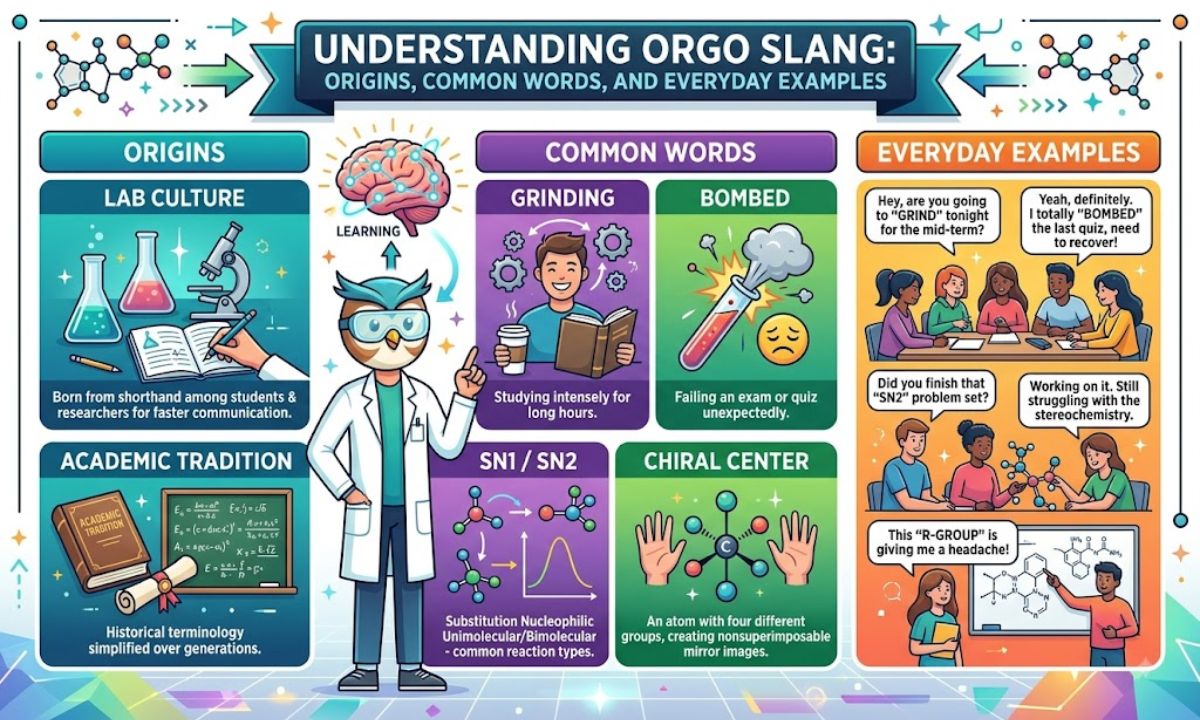
Orgo slang didn’t start as internet culture — it grew out of real classrooms. The earliest use of this kind of shorthand traces back to student forums and chemistry club discussions in the early 2000s, when students began abbreviating reactions and mechanisms for faster communication. Terms describing common reaction types started appearing in casual study conversations well before social media turned them into memes.
As online platforms like Reddit, Discord, and later TikTok became more popular among students, this classroom shorthand spread beyond lecture halls and into digital spaces where people shared both notes and humor about the subject. What began as a practical way to survive a brutal course eventually became a recognizable piece of student culture — something people reference even outside of chemistry class, simply because everyone remembers how hard it was.
Core Orgo Slang Terms and What They Mean
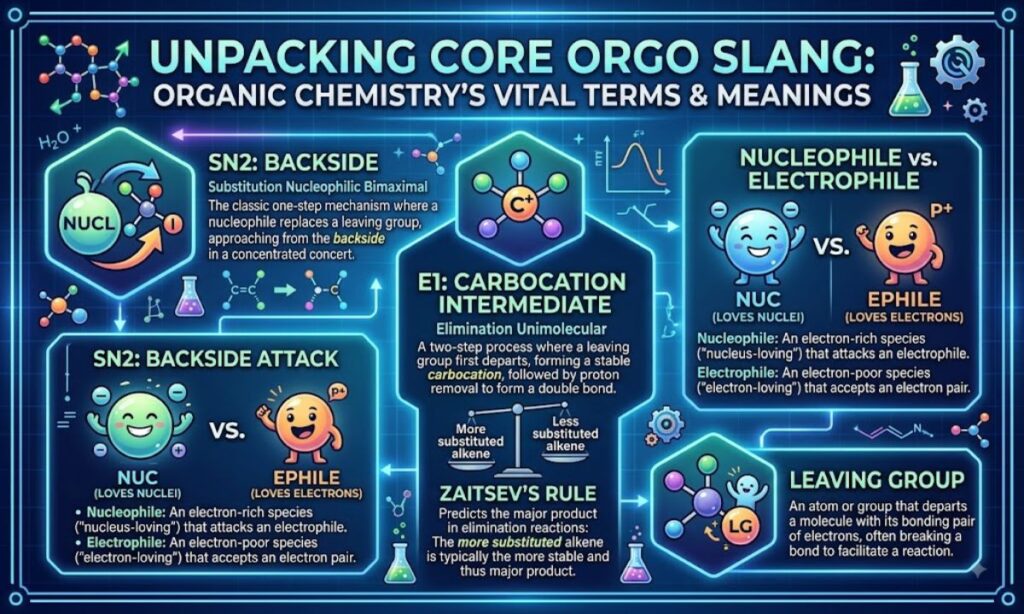
Beyond the word “orgo” itself, organic chemistry has generated its own mini-vocabulary. Here are some of the terms students commonly toss around:
- SN1 / SN2 — Shorthand for two major types of substitution reactions; often used casually to describe how a molecule behaves rather than writing out the full mechanism
- E1 / E2 — Abbreviations for elimination reactions, frequently mentioned alongside SN1/SN2 when comparing reaction pathways
- Curly arrows — A nickname for the arrows used to show how electrons move during a reaction
- Nuc / nucleophile — Shortened reference to a nucleophile, a molecule that “attacks” during a reaction
- Proton shuffle — A playful term describing the rapid transfer of protons in acid-base steps
- Mechanism / mech — The step-by-step explanation of how a reaction happens
These terms aren’t official chemistry vocabulary in the strict textbook sense — they’re the language students use to talk to each other quickly and, often, to make an overwhelming subject feel a little more manageable.
Orgo Slang in Action: Real Examples
Seeing these terms in context makes them easier to understand. Here’s how students typically use orgo slang in everyday conversation:
- Group chat: “Studying for orgo all night, send help.”
- Study group: “Weak nucleophile, protic solvent — that’s SN1.”
- Text to a friend: “Can’t hang out, I’ve got an orgo midterm Monday.”
- Social media caption: “Me vs. orgo lab reports this week.”
- Casual complaint: “This mechanism is acting shady today.”
Notice how the tone shifts depending on the setting — technical and precise in a study group, exaggerated and humorous on social media. That flexibility is part of what makes orgo slang so widely used.
When Orgo Sounds Informal
Context matters a lot here. When someone says “orgo” in a lab, a study session, or a science-heavy conversation, it’s understood as a normal, harmless abbreviation. But drop it into a completely unrelated conversation, and it can sound out of place or confusing to someone who isn’t in a science program.
That informality is intentional. Students use “orgo” partly because it’s efficient, but also because it signals shared experience — a kind of shorthand that says “I get how hard this class is” without needing to explain further.
Academic Shortcut vs. Slang
It’s worth drawing a line between “orgo” as an academic shortcut and “orgo” as slang, because the two overlap but aren’t identical.
| Aspect | Academic Shortcut | Slang Usage |
| Purpose | Saves time when discussing coursework | Expresses humor, stress, or shared struggle |
| Setting | Classrooms, labs, academic emails | Group chats, memes, social media |
| Tone | Neutral, practical | Playful, exaggerated, emotional |
| Formality | Still avoided in official documents | Fully informal |
In formal writing — lab reports, research papers, official emails — “organic chemistry” is still spelled out in full. “Orgo” stays firmly in the casual, spoken, and text-based world.
Orgo Meaning in Spanish
There isn’t a direct Spanish word for “orgo.” When the phrase comes up in Spanish-language contexts, it’s generally understood as an informal reference to “química orgánica,” which is simply the Spanish term for organic chemistry. In other words, the meaning doesn’t change across languages — it’s the same academic subject, just referenced with the same kind of casual shorthand students use in English. MaeninggGrameZo
How to Respond to Orgo Slang
If someone mentions “orgo” and you’re not sure how to reply, a few safe responses work in almost any situation:
- Acknowledge the struggle — “Orgo is brutal, good luck!” works in nearly every casual context.
- Ask for context — If it’s a technical term like SN1 or E2 and you’re unfamiliar, it’s completely fine to ask what it means.
- Match the tone — If the message is playful (“orgo is killing me 😭”), a light, sympathetic reply fits better than a technical one.
- Keep it simple — You don’t need chemistry knowledge to respond; understanding that “orgo” means organic chemistry is usually enough.
Final Words
“Orgo” is a small word carrying a lot of shared history — part academic necessity, part inside joke, part genuine venting about one of the toughest courses in a science curriculum. Whether it shows up as a quick classroom abbreviation or a meme caption, the core meaning stays the same: organic chemistry, spoken in the language of the students who live through it.
Frequently Asked Questions
What does “orgo” mean in text messages?
It almost always refers to organic chemistry, the college-level chemistry course focused on carbon-based compounds.
Is “orgo” the same as “ochem”?
Yes, both terms refer to the same subject and are used interchangeably depending on personal or regional preference.
Where did orgo slang originate?
It started in early student forums and chemistry study groups in the early 2000s before spreading to social media.
Does “orgo” have a different meaning in Spanish?
No — in Spanish contexts it’s understood as shorthand for “química orgánica,” the same subject referenced in English.
Is “orgo” appropriate to use in formal writing?
No, formal documents and reports typically use the full term “organic chemistry” instead.
Why do students use orgo slang instead of technical terms?
It saves time, builds a sense of community, and makes a difficult subject feel a bit more approachable.