
The letter X doesn’t show up often in science class, but when it does, it usually means something interesting is happening — a mysterious form of energy, a plant surviving the desert, or even the search for alien life. While letters like S or C dominate scientific vocabulary, X carves out a small but fascinating corner of biology, chemistry, physics, and astronomy.
This guide breaks down the most useful and interesting science words that start with X, organized by grade level and topic so students, teachers, and curious readers can find exactly what they need — without wading through filler.
Why Science Words Starting With X Are Worth Learning
Even though X is one of the rarest starting letters in the English language, X-words tend to carry outsized meaning. Many trace back to Greek roots like xenos (foreign or strange) or xeros (dry), which is why you’ll notice a pattern: words about “the unknown,” “the foreign,” or “dryness” repeat throughout this list.
Learning these terms helps with:
- Building stronger scientific vocabulary for exams and vocabulary quizzes
- Understanding medical imaging terms like X-ray-based diagnostics
- Recognizing plant adaptation concepts in biology class
- Getting comfortable with astronomy and space-science terminology
Science Words That Start With X (Core List)
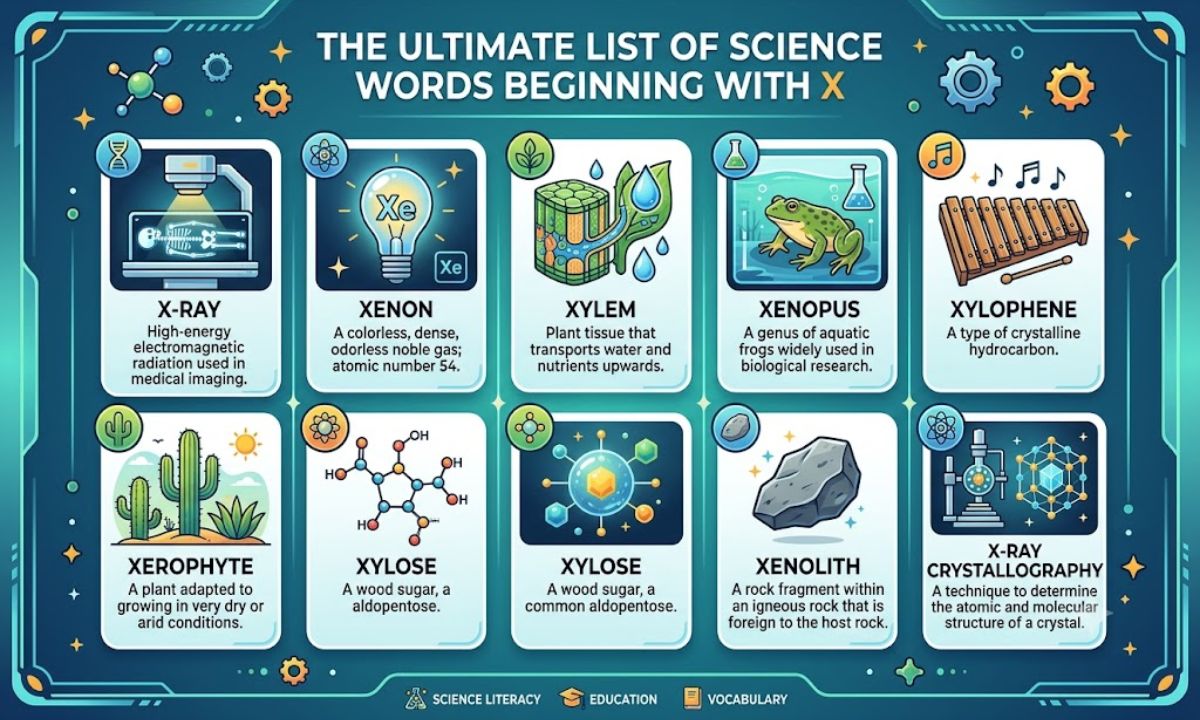
Here’s a quick-reference table of the most important X science words, what field they belong to, and a simple definition.
| Word | Science Field | Simple Definition |
| Xenobiology | Biology/Astrobiology | Study of life forms different from life on Earth |
| Xenogenesis | Biology | Production of offspring completely unlike either parent |
| X-ray | Physics/Medicine | High-energy radiation used to see inside objects or bodies |
| X-ray Astronomy | Astronomy | Study of X-ray emissions from space objects |
| X-ray Crystallography | Chemistry | Technique to determine the structure of molecules using X-rays |
| Xenopsychology | Psychology/Biology | Study of the possible psychology of non-human or alien minds |
| Xerophyte | Botany | A plant adapted to survive in dry, arid environments |
| Xylem | Botany | Plant tissue that transports water from roots to leaves |
| Xenon | Chemistry | A colorless, odorless noble gas used in lighting |
| Xanthophyll | Biology/Chemistry | A yellow pigment found in plant leaves |
Below, each of the key terms from this list is explained in more depth.
Xenobiology

Xenobiology is the study of biology that doesn’t follow the “normal” rules of life as we know it on Earth. It covers two main ideas: the search for extraterrestrial life forms, and the creation of synthetic organisms built from different chemical building blocks than the ones found in nature (like alternate DNA structures).
Scientists working in xenobiology often ask questions such as:
- Could life exist using a different genetic code than DNA?
- What would biology look like on a planet with a completely different atmosphere?
- Can synthetic biology create organisms that don’t rely on carbon-based chemistry?
This field overlaps heavily with astrobiology and synthetic biology, making it one of the more futuristic entries on this list.
Xenogenesis

Xenogenesis refers to the (largely disproven, historically theorized) idea that an organism could produce offspring completely different from itself — essentially a parent giving rise to an entirely different species. While this isn’t accepted as biologically accurate today, the term still appears in genetics discussions and science fiction, where it’s often used to describe extreme mutation or hybridization events.
In modern usage, it’s more of a historical or literary science term than an active area of laboratory research.
X-ray Astronomy
X-ray astronomy is the branch of astronomy that studies X-ray emissions coming from objects in space, such as black holes, neutron stars, and supernova remnants. Since X-rays are absorbed by Earth’s atmosphere, this type of astronomy relies on space-based telescopes like the Chandra X-ray Observatory.
Why it matters:
- Helps scientists detect black holes that can’t be seen with visible light
- Reveals extremely hot regions of space, often millions of degrees
- Provides insight into violent cosmic events like star collisions
X-ray Crystallography
X-ray crystallography is a laboratory technique used to figure out the exact 3D structure of molecules — including proteins and DNA — by studying how X-rays bend as they pass through a crystallized sample. This method was famously used to help discover the double-helix structure of DNA.
It remains one of the most important tools in chemistry and molecular biology today, especially for drug development and understanding how enzymes work.
Xenopsychology
Xenopsychology is a niche and largely theoretical field that explores what the psychology or mental processes of non-human or extraterrestrial beings might look like. It draws from comparative psychology, animal cognition studies, and speculative science to ask how “different” a mind could be from a human one.
While it isn’t a mainstream, heavily funded discipline, it comes up in discussions about animal intelligence, artificial intelligence, and the search for alien life.
Xerophyte
A xerophyte is a plant that has adapted to survive in extremely dry environments, such as deserts. Cacti are the most well-known example.
Common xerophyte adaptations include:
- Thick, waxy outer layers (cuticles) that reduce water loss
- Small or spine-like leaves to minimize evaporation
- Deep or widespread root systems to capture scarce water
- Water-storing tissues, like those found in succulents
Xerophytes are a favorite topic in middle school biology because they clearly show how organisms adapt to their environment.
Science Words That Start With X, By Grade Level
Different grade levels focus on different types of X-words, ranging from simple, everyday terms to more advanced scientific vocabulary. Here’s a general breakdown.
Science Words That Start With X for Kids
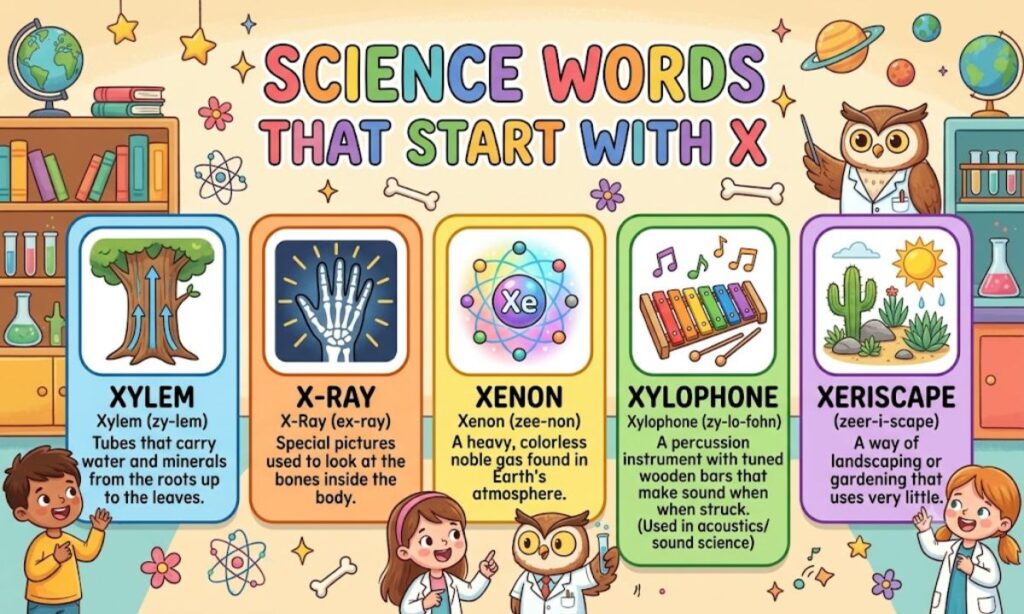
Young learners usually start with simple, familiar concepts:
- X-ray – A picture that shows the inside of your body or an object
- Xylophone (often included in early science/music crossover lessons)
- X-axis – The flat, side-to-side line on a graph
Science Words That Start With X, 5th Grade
- X-axis
- Xylem
- Xenon
Science Words That Start With X, 6th Grade
- Xerophyte
- Xylem (in more depth — including transport systems in plants)
- X-ray imaging
Science Words That Start With X, 7th Grade
- X-ray diffraction (basic introduction)
- Xanthophyll
- Xenobiotic (a foreign chemical substance found in an organism)
Science Words That Start With X, 8th Grade
- X-ray crystallography (introductory level)
- Xenobiology (basic concepts)
- Xerophthalmia (a medical condition caused by vitamin A deficiency)
This progression mirrors how most science curriculums work: starting with visible, concrete ideas (like X-rays and graphs) before moving into cellular, chemical, and molecular-level concepts.
Quick Comparison: Everyday vs Advanced X-Words
| Category | Examples | Typical Audience |
| Everyday/Basic | X-ray, X-axis, Xylem | Elementary–middle school |
| Botany-Focused | Xerophyte, Xanthophyll, Xylem | Middle school biology |
| Chemistry/Physics | Xenon, X-ray crystallography, X-ray diffraction | High school–college |
| Advanced/Theoretical | Xenobiology, Xenogenesis, Xenopsychology | College and beyond |
Final Words
Science words that start with X may be few in number, but they’re rich in meaning. From the deep-space mysteries explored through X-ray astronomy to the everyday resilience of a xerophyte surviving in the desert, these terms show just how much scientific ground a single letter can cover.
Whether you’re a student working through a vocabulary list, a teacher building a lesson plan, or simply someone who enjoys expanding their scientific vocabulary, this list offers a solid foundation — from simple, kid-friendly terms all the way up to advanced, research-level concepts.
Frequently Asked Questions
What is the most common science word that starts with X?
X-ray is by far the most widely recognized, used across medicine, physics, and astronomy.
Is xenobiology a real scientific field?
Yes, it’s a legitimate area of study connected to astrobiology and synthetic biology, though much of it remains theoretical.
What does xerophyte mean in simple terms?
It’s a plant, like a cactus, that has adapted to survive with very little water.
Why do so many X science words come from Greek?
Because Greek prefixes like “xeno-” (foreign) and “xero-” (dry) were commonly used by early scientists naming new concepts.
What grade level typically introduces xylem and xerophyte?
These are most commonly taught around 5th to 6th grade during plant biology units.