
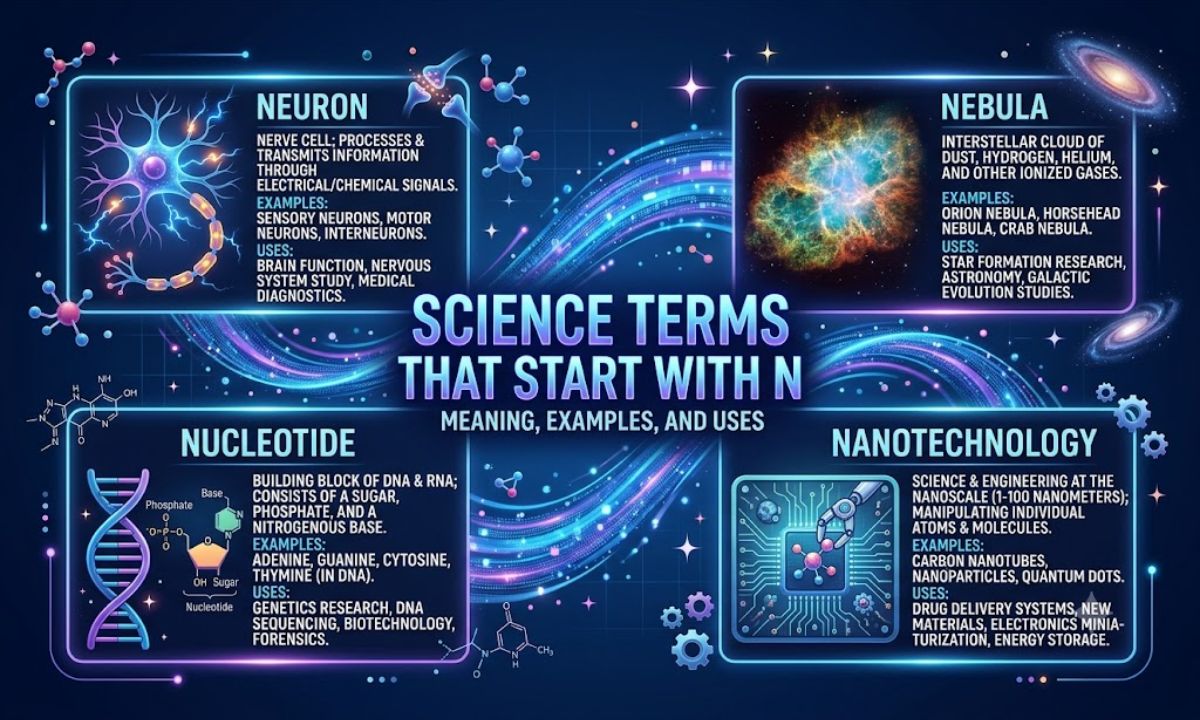
Science has a language of its own, and the letter “N” contributes some of its most important vocabulary. From the particles that hold atoms together to the clouds of gas that give birth to stars, “N” words appear across physics, biology, chemistry, and astronomy. Whether you’re a student prepping for an exam, a parent helping with homework, or simply curious about how science describes the world, this guide breaks down the most useful science terms starting with N in plain, easy-to-understand language.
Let’s explore what makes these words so essential to scientific understanding.
Nature: The Foundation of Scientific Study
Nature refers to the physical world and everything in it that exists without human interference — plants, animals, mountains, oceans, weather patterns, and entire ecosystems. It’s the starting point for almost every branch of science, especially biology, ecology, and environmental science.
Key points about nature in science:
- It includes both living organisms (plants, animals, microbes) and non-living elements (rocks, water, air)
- Scientists study nature to understand relationships between organisms and their environment
- It forms the basis of fields like ecology, geology, and earth science
- Observing nature helps researchers track climate change, biodiversity loss, and conservation needs
Example: A forest ecosystem, where trees, animals, soil, and climate interact, is a small-scale representation of nature at work.
Neuron: The Building Block of the Nervous System
A neuron is a specialized nerve cell that transmits electrical and chemical signals throughout the body. Neurons are the core components of the brain, spinal cord, and nervous system, allowing us to think, move, feel, and react.
How neurons work:
| Part of Neuron | Function |
|---|---|
| Dendrites | Receive signals from other neurons |
| Cell body (soma) | Processes the signal and keeps the cell alive |
| Axon | Carries the signal away to other cells |
| Synapse | The gap where signals pass to the next neuron |
Example: When you touch something hot, neurons in your skin send a rapid signal to your brain, triggering an instant reflex to pull your hand away.
Nucleus: The Control Center of the Cell
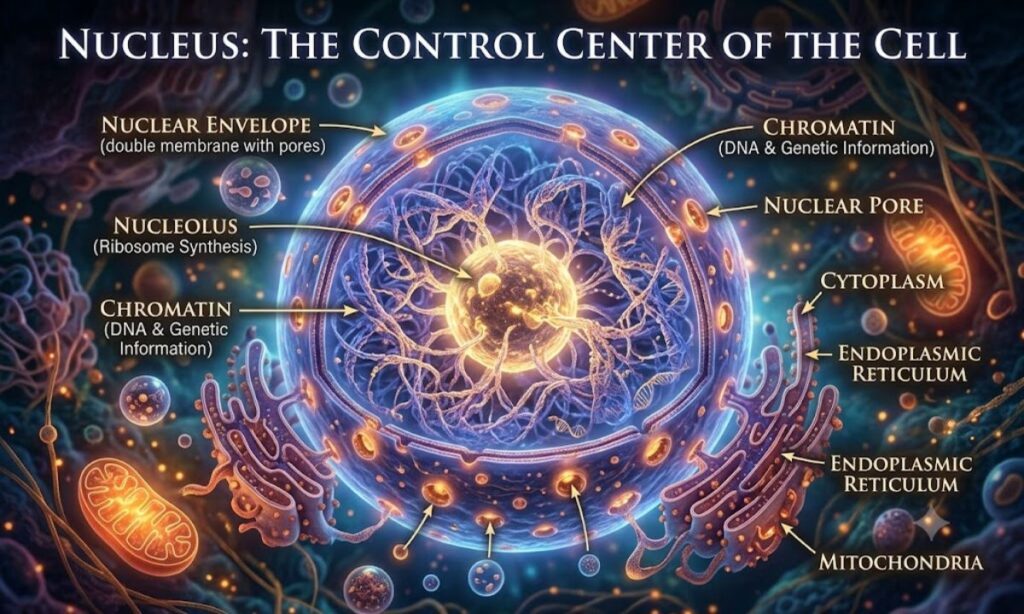
In biology, the nucleus is the command center of a cell. It houses DNA, the genetic material that controls growth, reproduction, and cell function. Without a nucleus, a cell wouldn’t know how to build proteins or divide properly.
Interestingly, the word “nucleus” also appears in physics and chemistry — it means something slightly different in each field.
| Field | Meaning of Nucleus |
|---|---|
| Biology | The membrane-bound structure containing a cell’s DNA |
| Chemistry/Physics | The dense central core of an atom, made of protons and neutrons |
| Astronomy | The solid core of a comet |
Example: Human cells (except red blood cells) each contain a nucleus that safeguards genetic instructions.
Neutron: A Key Subatomic Particle
A neutron is one of the three main subatomic particles, alongside protons and electrons. It sits inside the atomic nucleus and carries no electric charge, which is why it’s called “neutral.”
Quick facts about neutrons:
- Found in the nucleus of nearly every atom (except standard hydrogen)
- Have roughly the same mass as protons
- Changing the number of neutrons in an atom creates isotopes of the same element
- Essential to nuclear reactions, including the ones that power nuclear plants
Example: Carbon-14, used in radiocarbon dating, has two extra neutrons compared to standard carbon-12, making it useful for measuring the age of ancient artifacts.
Nanotechnology: Science at the Smallest Scale
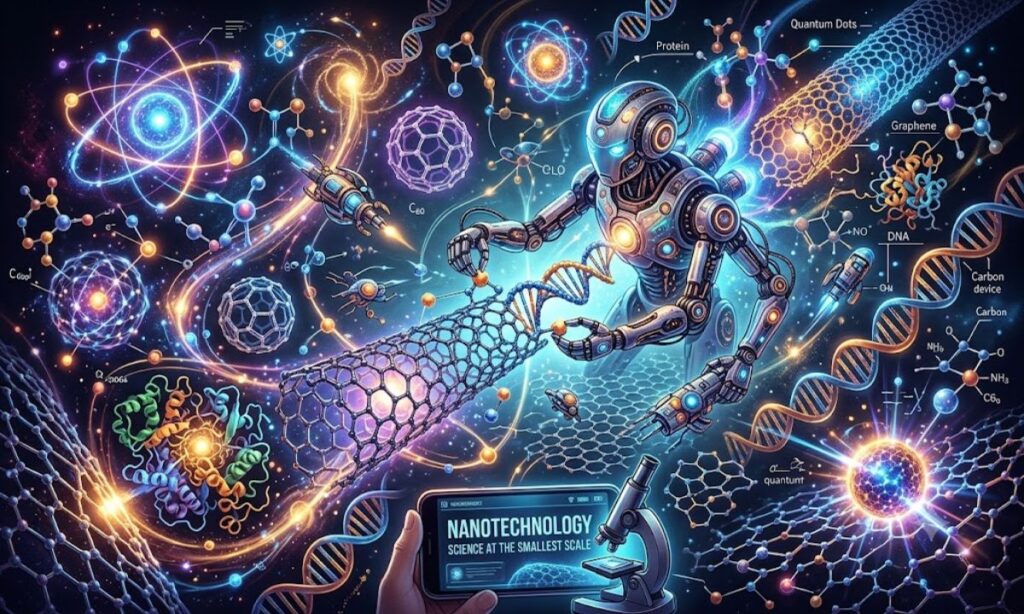
Nanotechnology is the branch of science that deals with manipulating matter at an incredibly tiny scale — typically between 1 and 100 nanometers. To put that in perspective, a single strand of human hair is about 80,000–100,000 nanometers wide.
Why nanotechnology matters:
- Used in medicine to design targeted drug-delivery systems
- Powers advances in electronics, like faster and smaller computer chips
- Improves materials science, creating stronger, lighter substances
- Plays a role in energy storage, including better batteries and solar cells
Example: Nanoparticles are now used in some cancer treatments to deliver medication directly to tumor cells while sparing healthy tissue.
Nebula: The Birthplace of Stars
A nebula is a massive cloud of gas and dust in space. The word comes from Latin, meaning “mist” or “cloud” — a fitting description for these swirling, colorful formations often seen in telescope images.
Types of nebulae:
- Emission nebulae – Glow due to energized gas, often around young stars
- Reflection nebulae – Reflect the light of nearby stars without glowing themselves
- Planetary nebulae – Formed from the outer layers of dying stars
- Dark nebulae – Dense clouds that block light from objects behind them
Example: The Orion Nebula is one of the most famous star-forming regions visible from Earth, even with basic telescopes.
More Science Words Starting With N
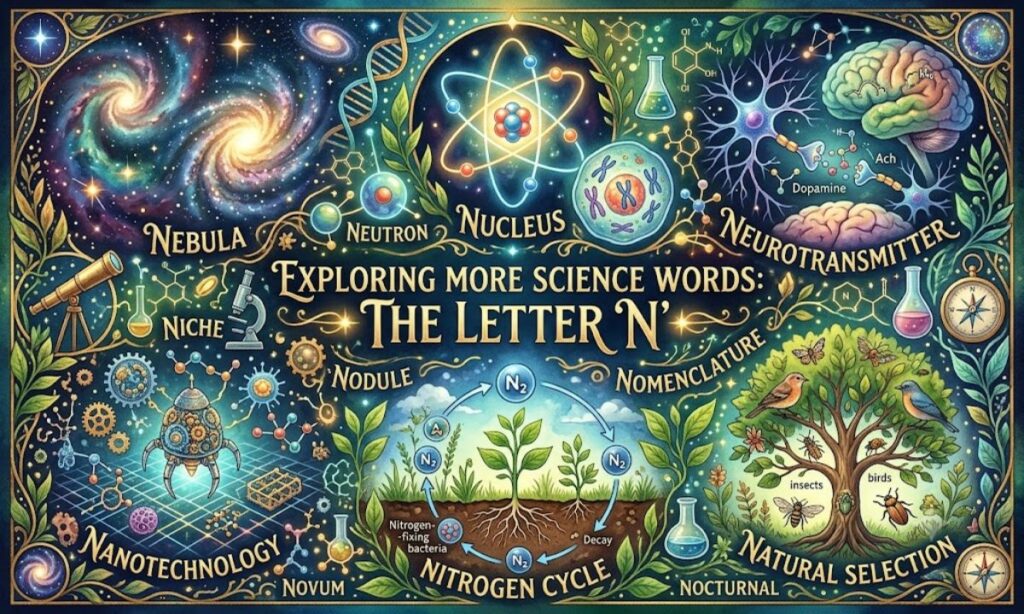
Beyond the six core terms above, here are additional science vocabulary words starting with N that are commonly studied across subjects.
| Term | Meaning |
|---|---|
| Newton | The unit used to measure force |
| Nitrogen | A gas making up about 78% of Earth’s atmosphere |
| Nuclear fusion | The process where atomic nuclei combine, releasing energy |
| Nucleotide | The building block of DNA and RNA |
| Natural selection | The process by which organisms better adapted to their environment survive and reproduce |
| Nervous system | The network of nerves and neurons that control body functions |
| Niche | The specific role an organism plays within its ecosystem |
| Neutrino | A nearly massless particle that rarely interacts with matter |
| Nonrenewable energy | Energy sources, like coal or oil, that cannot be replenished quickly |
| Nematode | A type of roundworm studied in biology |
These words frequently appear in school curriculums, especially around the 6th-grade level, when students are introduced to foundational scientific vocabulary in physics, biology, and earth science.
Why Learning Science Words Starting With N Matters
Understanding these terms isn’t just about memorizing definitions — it builds a foundation for grasping bigger scientific ideas.
- Improves comprehension of textbooks, news articles, and research papers
- Supports academic performance in biology, chemistry, and physics classes
- Builds real-world awareness of topics like nuclear energy, nanotechnology, and space exploration
- Prepares students for standardized tests and science competitions
Final Words
Science words that start with N span an incredible range — from the invisible neutron inside an atom to the vast, glowing nebulae light-years away. Terms like neuron, nucleus, and nanotechnology aren’t just vocabulary for a test; they represent the building blocks of how we understand life, matter, and the universe. By learning these words in context — with real examples and simple explanations — students and curious minds alike can strengthen their grasp of science and see how these concepts connect across biology, chemistry, physics, and astronomy.
Keep exploring, keep asking questions, and let these “N” words open the door to a deeper appreciation of the natural world.
Frequently Asked Questions
Q1. What are some common science words that start with N?
Common examples include nature, neuron, nucleus, neutron, nanotechnology, and nebula, along with terms like nitrogen and natural selection.
Q2. What is the easiest N science word for kids to learn?
Simple words like nature, nerve, and newton are easy starting points for younger learners.
Q3. Are there N science words used in computer science?
Yes, terms like network, node, and neural network are common in computer science and technology.
Q4. What is the difference between a neuron and a nucleus?
A neuron is a nerve cell that sends signals through the body, while a nucleus is the control center of a cell that stores genetic material.
Q5. Why is nanotechnology important in science?
Nanotechnology allows scientists to build materials and devices at an extremely small scale, improving medicine, electronics, and energy systems.
Q6. What science words that start with N are taught in 6th grade?
Typical 6th-grade terms include nature, nucleus, neuron, nitrogen, natural selection, and nervous system.
Q7. How can I remember N science words more easily?
Using flashcards, real-life examples, diagrams, and grouping words by subject (biology, physics, astronomy) makes memorization easier.