
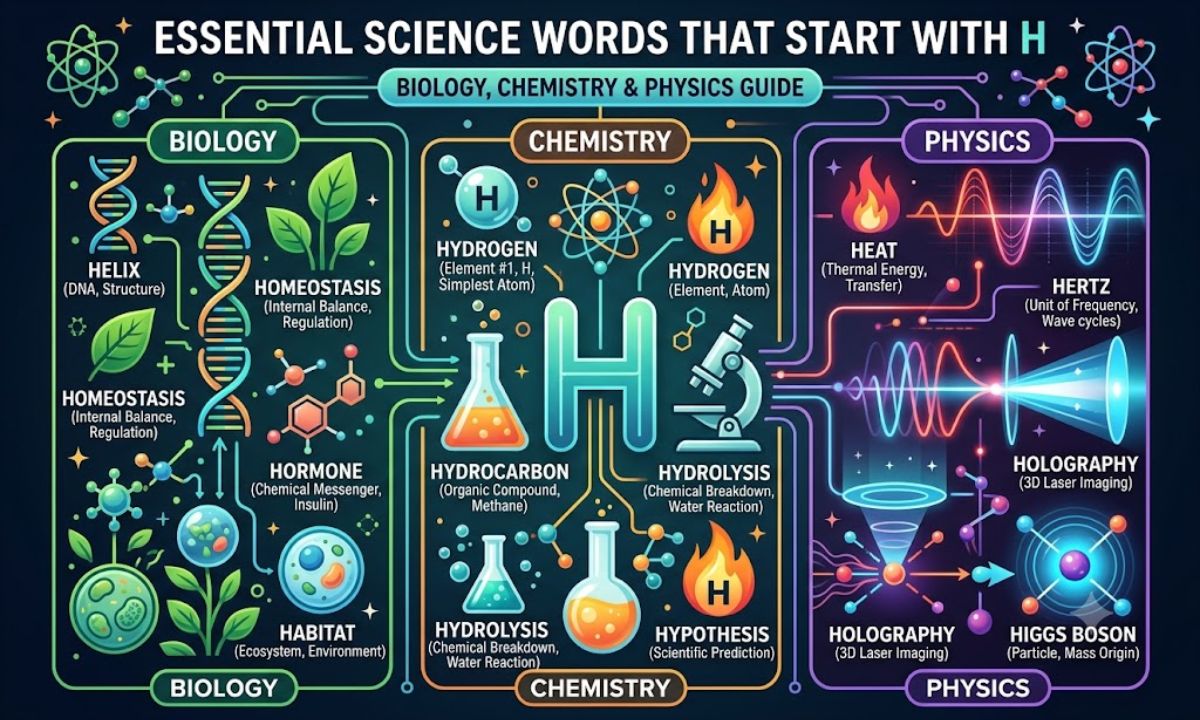
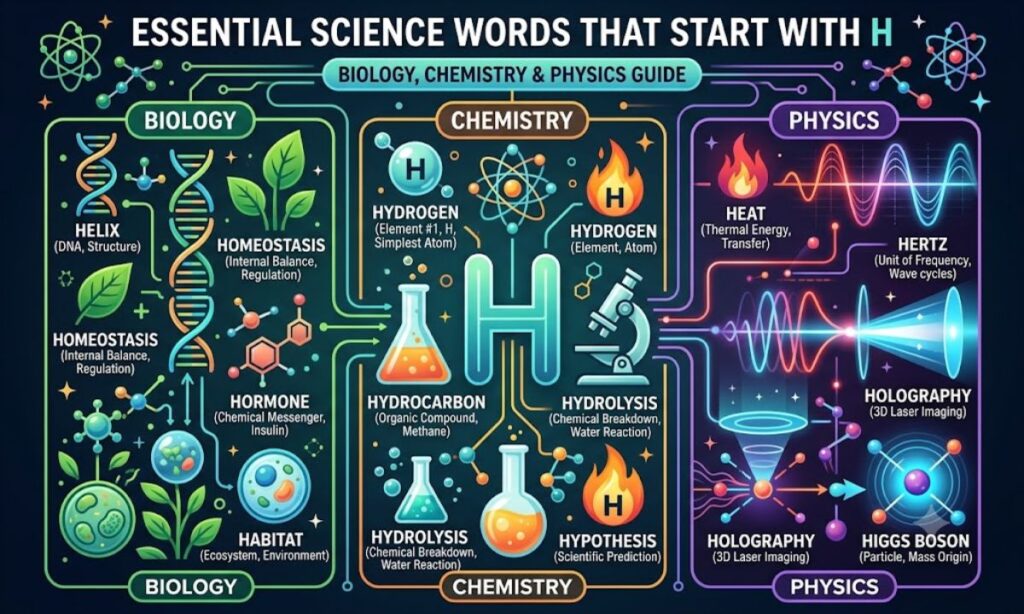
Science is full of “H” words — from the hydrogen atom that fuels every star in the sky to the hydrosphere that covers our planet in water. Whether you’re a student prepping for an exam, a parent helping with homework, or just someone who loves expanding their vocabulary, this guide breaks down the most important H science words in simple, easy-to-understand language.
Below, you’ll find clear definitions, real-world examples, and grade-level word lists covering biology, chemistry, physics, and earth science — all in one place.
List Of Science Words That Start With H
Here’s a quick-reference table of commonly used H science words, organized by the subject they belong to most often.
| Word | Field | Simple Meaning |
| Hydrogen | Chemistry/Physics | The lightest and most abundant element in the universe |
| Heliocentric Model | Astronomy/Physics | The idea that the sun is the center of the solar system |
| Hydrosphere | Earth Science | All the water found on, under, and above Earth’s surface |
| Hybridization | Chemistry | The mixing of atomic orbitals to form new, equal-energy orbitals |
| Hydraulics | Physics/Engineering | The use of liquid pressure to create movement or force |
| Habitat | Biology | The natural home or environment of a plant or animal |
| Heredity | Biology | The passing of traits from parents to offspring |
| Hormone | Biology | A chemical messenger produced by glands in the body |
| Hemoglobin | Biology | The protein in red blood cells that carries oxygen |
| Homeostasis | Biology | The body’s ability to maintain a stable internal environment |
| Hertz (Hz) | Physics | The unit used to measure frequency (cycles per second) |
| Half-life | Chemistry/Physics | The time it takes for half a radioactive substance to decay |
| Hypothesis | General Science | A testable explanation or educated guess |
| Humidity | Earth Science | The amount of water vapor present in the air |
| Hydrocarbon | Chemistry | A compound made only of hydrogen and carbon atoms |
Now let’s look closer at some of the most essential H-words every student should know.
Hydrogen
Hydrogen sits at position number one on the periodic table — and for good reason. It’s the simplest, lightest, and most abundant element in the entire universe, making up roughly 75% of all known matter.
Key facts about hydrogen:
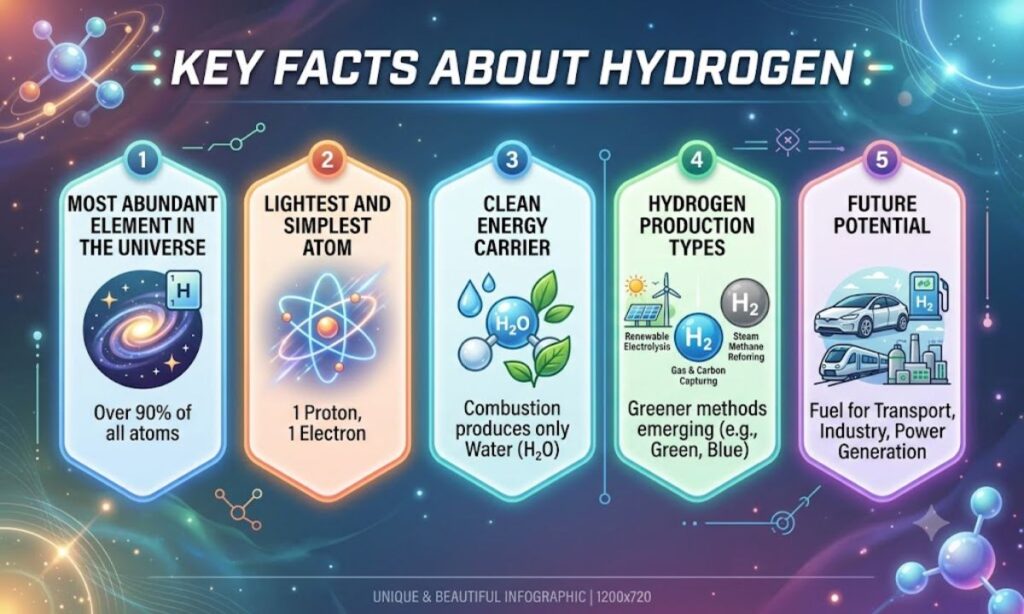
- Symbol: H, Atomic Number: 1
- Colorless, odorless, and highly flammable gas at room temperature
- The main fuel that powers stars, including our sun, through nuclear fusion
- Combines with oxygen to form water (H₂O)
- Used in fuel cells as a clean energy source for vehicles
In chemistry class, hydrogen usually shows up early because it’s the building block for understanding atomic structure, bonding, and the periodic table itself. In physics, it’s central to discussions of nuclear fusion and stellar energy.
Science Words That Start With H — With Meaning
If you’re looking for a broader vocabulary list, here are more H-words grouped by meaning and difficulty, useful for different age groups and classroom levels.
Science Words That Start With H (5th Grade)
These are simpler, everyday science terms appropriate for younger learners:
- Habitat – where an animal or plant naturally lives
- Heat – energy that makes things warm
- Hill – a raised area of land, smaller than a mountain
- Herbivore – an animal that eats only plants
- Hibernation – a resting state some animals enter during winter
Science Words That Start With H (6th Grade)
- Humidity – moisture in the air
- Hemisphere – half of the Earth (Northern or Southern)
- Hydroelectric – electricity generated from moving water
- Hydrology – the study of water movement on Earth
- Hazard – a source of danger or risk
Science Words That Start With H (7th Grade)
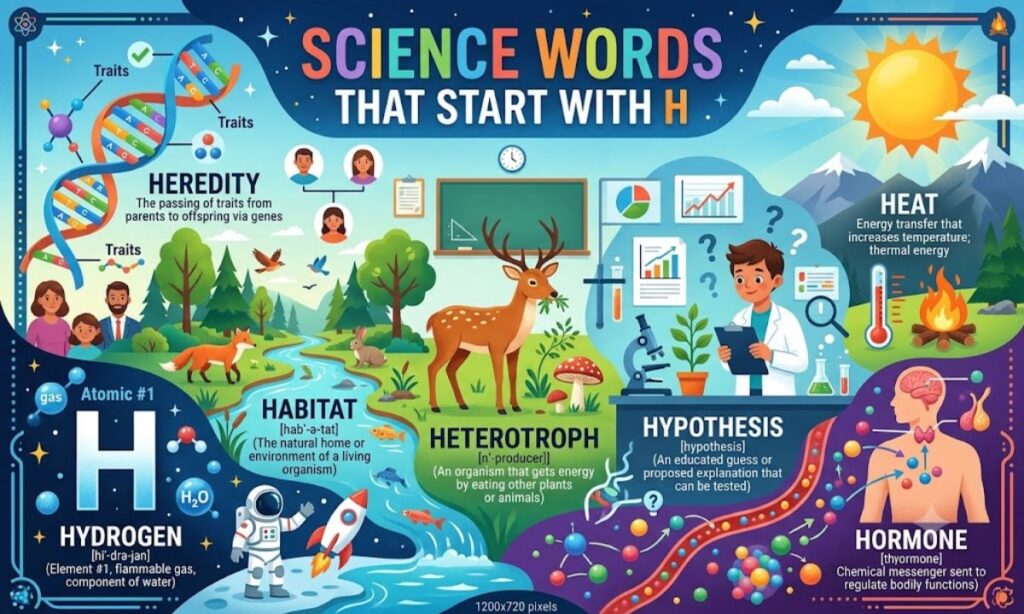
- Homeostasis – the body keeping its internal conditions stable
- Hybrid – offspring from two different species or varieties
- Hydrosphere – all water on Earth’s surface
- Hormone – a chemical signal in the body
- Hertz – unit for measuring wave frequency
Science Words That Start With H (8th Grade)
- Hydrocarbon – a compound of only carbon and hydrogen
- Heliocentric – sun-centered model of the solar system
- Hybridization – blending of atomic orbitals in chemistry
- Half-life – decay time for radioactive elements
- Hydraulics – using fluid pressure for mechanical work
This tiered approach helps students build vocabulary gradually, moving from concrete, observable concepts (heat, habitat) toward more abstract, technical terms (hybridization, half-life) as they advance through school.
Heliocentric Model
The heliocentric model is the scientific idea that the sun — not the Earth — sits at the center of the solar system, with planets orbiting around it. This concept was proposed by astronomer Nicolaus Copernicus in the 16th century, challenging the older geocentric (Earth-centered) view that had dominated for centuries.
Why it matters:
- It correctly explains planetary motion and the phases of the moon
- It laid the foundation for modern astronomy and physics
- Later supported by scientists like Galileo Galilei and Johannes Kepler
Today, the heliocentric model is a cornerstone concept in earth science and astronomy classes, often used to explain seasons, eclipses, and the structure of our solar system.
Hydrosphere
The hydrosphere refers to all the water found on, above, and below the surface of the Earth. This includes oceans, rivers, lakes, glaciers, groundwater, and even the water vapor in our atmosphere.
Components of the hydrosphere:
- Oceans – covering about 71% of Earth’s surface
- Freshwater – rivers, lakes, and streams
- Groundwater – water stored underground in aquifers
- Ice – glaciers, polar ice caps, and permafrost
- Atmospheric water – clouds and water vapor
The hydrosphere is closely connected to other Earth systems, like the atmosphere (air) and biosphere (living things), through processes such as the water cycle — evaporation, condensation, and precipitation.
Hybridization (Chemistry)
In chemistry, hybridization describes how atomic orbitals mix together to form new orbitals of equal energy. This concept helps explain the shapes of molecules and how atoms bond with each other.
Common types of hybridization:
| Type | Orbitals Mixed | Shape | Example |
| sp | 1 s + 1 p | Linear | CO₂ |
| sp² | 1 s + 2 p | Trigonal planar | BF₃ |
| sp³ | 1 s + 3 p | Tetrahedral | CH₄ (methane) |
Understanding hybridization is essential for predicting molecular geometry, which in turn affects a compound’s physical and chemical properties — like boiling point, polarity, and reactivity.
Hydraulics
Hydraulics is the branch of physics and engineering that studies how liquids under pressure can be used to generate, control, and transmit force. It’s based on the principle that liquids are nearly incompressible, so pressure applied at one point transfers efficiently through the fluid.
Real-world applications of hydraulics:

- Car brakes and hydraulic lifts in auto shops
- Construction equipment like excavators and cranes
- Airplane landing gear and control systems
- Dams and water-powered machinery
Hydraulics is a great example of how a physics concept translates directly into everyday technology — it’s the reason a small amount of force applied to a hydraulic pedal can lift something as heavy as a car.
Final Words
Science words that start with H span an impressive range — from the hydrogen atoms fueling distant stars to the hormones regulating your own body. Learning these terms doesn’t just help with exams; it builds a foundation for understanding how the natural and physical world actually works. Whether you’re a 5th grader learning about habitats or a chemistry student tackling hybridization, mastering these H-words is a solid step toward stronger scientific literacy.
Keep this list handy as a quick reference, and try using a few new words in a sentence each week — it’s one of the simplest ways to make vocabulary stick for the long term.
Frequently Asked Questions
What does heliocentric mean in simple terms?
Heliocentric means “sun-centered” — it describes the model where planets orbit the sun rather than the sun orbiting Earth.
What is hydrosphere in one sentence?
The hydrosphere is all the water on Earth, including oceans, rivers, ice, and water vapor in the air.
Is homeostasis a biology or chemistry word?
Homeostasis is primarily a biology term, describing how living organisms maintain a stable internal environment despite external changes.
What are some easy H science words for kids?
Simple examples include heat, habitat, hill, herbivore, and hibernation — all concrete, easy-to-visualize concepts.
Why is hybridization important in chemistry?
Hybridization helps explain the actual 3D shape of molecules, which affects how they react, bond, and behave physically.